
Lets talk iconic knives.
-
As an outsider looking into a foreign culture regarding the Bowie knife it seems more that the appeal lies in the romantic notion of an every man's utilitarian rough and tumble tool over the highly structured ways of society. At that time if you wanted a bladed weapon it was the sabre that was the dominant thing and knives/daggers were backups or things of convenience. If you wanted something to dress different game animals with again there were more specialized butchering and skinning knives. If you were looking for utensils, you had your spoons, knives and forks for that as well.
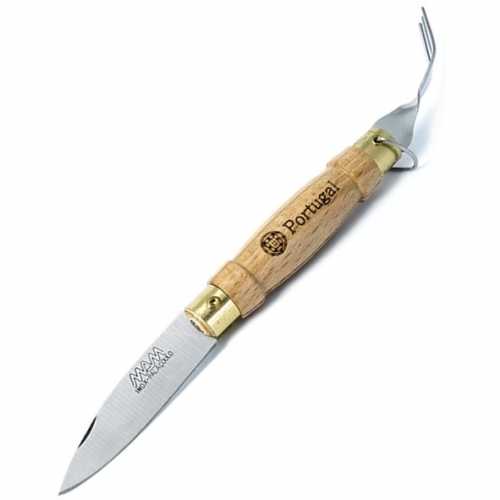
But a Bowie knife sounded less fancy, less specialized, more utilitarian, more common man, more like you and me. A knife that can cut the guy who had 3 aces hiding up his sleeve as well as field dress a boar or a jackrabbit and be used as a fork.
Plus it isn't hard to get those romantic notions today when we have a lot of resources to get information and many things can be tried out in a fairly safe environment. Just imagine how hard would it be to distinguish fact and fiction in those days if you had a strong marketing like CS has or a following like Busse -
Lots of folklore with the Bowie knife. While I've read a few accounts what certain is James Bowie killed a man with a knife. Scholars debate as to whether this was what is currently known as the Bowie knife. The originator is also debated however Rezin Bowies seems to be the inventor and whether or not he actually made it is still debated. Regardless IMO the Bowie knife as we know it is a knife that is widely known. John Bowie certainly helped continue to tell tales of his bothers "exploits". As we know, sometimes even those who witness something retell the occurrence with "creative license".
-
In further thinking about this, scary right?
 The term used in both the thread subject line and subsequent attempts to discuss the topic may have began along the wrong path. The word iconic for me is now to narrow to properly define or attempt to define the blades mentioned.
I mentioned earlier in the thread a word used to define iconic, formulaic. I thought this was a path worth looking into. Take the Khukuri for example. The Greek Kopi is said to be and by all accounts ( by many ) is the father of the Khukuri. However the Khukuri stands on its own as a blade and symbol. Its recognized by most any average knife person and most people in general. This takes nothing away from the Kopi as a probable father of the Khukuri. Sharing DNA between them is interesting tho as we've seen with many blades its the tweaks and modifications that tend to make the incarnations their very own. Each blade certainly stands on their own and are part of a cultures singular identity. The Kopi being Greek and Khukuri Nepalese.
So, how shall we then define blades like these? Iconic certainly for me is sufficient in the most simplistic way. By definition the word is good for knives like the SAK and Buck 110. I'd agree that most knives/blades mentioned fall into the category of iconic. There are some knives/blades however that would tend to be more significant. Again we can use the example Khukuri. Yeah yeah nothing is so simple with knife people. For simplicity sake iconic works. For blades/knives the push past this definition I'd suggest Historic. I think this moves closer to where this discussion has been going. ThePeace broke down in his contribution an interesting subset classification. I do believe there still could be a "catchall" definition and iconic is probably the simplest. Iconic vs Historic is closer to that catchall tho even then I'm not certain. There may not be one word available when describing the vast blades we see as Iconic since some will tend to fall into another category or many.
The Khukuri is both Iconic and Historic. The Roman Gladius is said to be derived from the short sword of the Celtiberians. This Gadius is also both to many. While the Celtiberians sword may only be historical in nature and neither iconic nor historic.
-
"Historic" seems darned nebulous. Seems like a semantic trap.
A rusted, twisted Viking blade is, by default, 'historic': it's old and it sheds some more light onto a given period of time. Does that make it historically significant? Dunno..... And, in so far as no modern knife stands in isolation, but depends on the design influences of older, previous designs, any preceding knife must be considered 'historic'. Even a knife made today is 'historic' in the sense it will influence the knife made tomorrow (or the knives outlawed tomorrow) or become a footnote in the history of knives. Even if said knife is a flop and goes the way of the dodo. Where does history start? Ten seconds ago? Ten decades ago? Ten centuries ago?

-
I've been following this thread with interest.
I'd argue(lightheartedly) that there's fewer than we think....
As a kid,I knew Kukris and commando(Sykes-Fairbourn) knives from the war comics I read(Commando,Warlord,Victor and such). I knew smokers knives. Swiss Army knives I've somehow always known. Bowie knives you always saw in the cowboy movies
The (to me) classic American lock knife,typified by the Buck 110 I'd never known until I started getting my hands on American gun magazines in South Africa. Tactical folders I'd never really seen,or hadn't been aware of until arriving here. Likewise most classic patterns like Opinels,Mercators,stockmen etc...
I guess it depends on age and where you grew up
-
The closer we get the farther we move away
. There may very well be fewer than we'd like on the "list" :(. I'm certainly enjoying the responses and always enjoy any knife mentioned 
-
@Nix said:
And the kukri (khukuri) is still relevant today. It's still in use. While there are 'historic' examples of Kukris, it is still a very contemporary knife.ADD: So, I'd say the Kopis is a 'historic weapon', but kukri is not.
All to which makes a list more involved
. Heck even the Bowie on display at the Alamo looks nothing like the Bowie as we know it. Check that, there are iterations that become what we know as the Bowie knife. Once the tales took legs of their own makers made their "versions".Spoiler:
https://youtu.be/cngZF1S-IKU -
And the kukri (khukuri) is still relevant today. It's still in use. While there are 'historic' examples of Kukris, it is still a very contemporary knife.
ADD: So, I'd say the Kopis is a 'historic weapon', but kukri is not.
All to which makes a list more involved
. Heck even the Bowie on display at the Alamo looks nothing like the Bowie as we know it. Check that, there are iterations that become what we know as the Bowie knife. Once the tales took legs of their own makers made their "versions".Spoiler:
https://youtu.be/cngZF1S-IKUCool! I would go and see that

Sent fra min FRD-L09 via Tapatalk
-
@Aloha007 said:
Take the Khukuri for example. The Greek Kopi is said to be and by all accounts ( by many ) is the father of the Khukuri. However the Khukuri stands on its own as a blade and symbol. Its recognized by most any average knife person and most people in general. This takes nothing away from the Kopi as a probable father of the Khukuri.Iconic vs Historic is closer to that catchall tho even then I'm not certain. There may not be one word available when describing the vast blades we see as Iconic since some will tend to fall into another category or many.
The Khukuri is both Iconic and Historic. The Roman Gladius is said to be derived from the short sword of the Celtiberians. This Gadius is also both to many. While the Celtiberians sword may only be historical in nature and neither iconic nor historic.
let's not forget that many historians believe that the *Kukri *might have also had its roots in the Iberian Falcata, and also that the *Kopis *might have been an evolution of the Egyptian "Kopesh", adopting both the name and the curved, forward-weight blades with strongly contoured grip and hand protection
And, the Gladius might be "the" Roman weapon that comes to mind first, but what about the Pugio, the *Pilum *or the Spatha? They might not be as "iconic" but they sure were relevant and important to them, and as essential as the Gladius in the Roman Empire's success

-
@ThePeacent said:
let's not forget that many historians believe that the *Kukri *might have also had its roots in the Iberian Falcata, and also that the *Kopis *might have been an evolution of the Egyptian "Kopesh", adopting both the name and the curved, forward-weight blades with strongly contoured grip and hand protectionAnd, the Gladius might be "the" Roman weapon that comes to mind first, but what about the Pugio, the *Pilum *or the Spatha? They might not be as "iconic" but they sure were relevant and important to them, and as essential as the Gladius in the Roman Empire's success
Good points, El P.
Your comments go to emphasize what I was trying to say earlier--bladed tools and weapons are all part of a spectrum of design and technology. Each has evolved in it's own technological time period to meet the needs of the day. They've changed as technology and tasks have changed, but rely on earlier successes and failures. The history of the SAK is a perfect example: the Soldier of 1891 does not resemble the more iconic red Spartan of today.
I think that' why it is hard for me to see any one knife/sword/machete as being more 'historic' than another. Just as T.Rex is historic but no longer a viable animal for the current circumstances.
The term 'iconic' seems to be a more useful descriptor, in so far as some knives and swords seem to stand out as being particularly recognizable or emblematic of their era or uses. As you point out, the Gladius is the weapon that comes to mind, it's Iconic, whereas the Spatha seems less Iconic, though still quite important or relevant from a historical perspective.

-
Swords are starting to creep into the discussion. Aloha, do you want to limit this to knives? Or add all edged tools & weapons?
Swords will really open things up, but I think we were trying to develop a list of 'Iconic Knives'?
Do we even have a list started yet? :ahhh
What the heck is going on here!?
-
I like how this has evolved. Swords, knives, and everything else that has entered the discussion is wonderful. Getting back to the theme I will take a step back from over thinking. Certainly a discussion of iconic swords and knives are double the fun :D
Iconic. In the loosest definition for the average knife person. I'd say easily and readily recognizable. A person new to knives or a non knife person might very well be familiar with certain knives and not know their names. Perhaps those who are new to knives will easily recognize the SAK however not recognize the Opinel. The average knife person would have done some looking at models and thus be familiar with the Opinel if only by pictures.
Iconic knife. There is no prerequisite to own the knife. You do not need to know its origins or history. You do not need to know particular makers. Examples are the Bowie knife and Barlow.
An average knife person might be described as someone who owns a knife or knives. Someone who has looked at knives online or locally. A person who carries a knife and uses a knife other than in the kitchen. When talking about swords however this very well not apply. I'd say I am an average knife person yet I dont own a sword or machete. I am familiar with various swords and cutting tools like the machete and axes.
-
Iconic knife in some situations will be all encompassing. Example, Q-Tip and Kleenex, both are used by a lot of folks to describe a product. The names however are Brands of products, tissue and cotton swabs/buds respectively. This might be US only
 ? If I were to ask for a Q Tip or Kleenex I'd be handed the product without regard to the Brand I was actually asking for ( again might be US only ). If I asked for a Coke and only Pepsi was available I'd be asked if Pepsi was ok. I mention this because for many these two are very different for most if not all.
Swiss Army Knife I think is similar to what I am trying to work out in my head. A CAK would be called Swiss Army Knife by many non knife people unfortunately. I'd hope the average knife person knows the difference
 . I think so. That being said, does the average knife person know the different companies that produced Swiss Army Knives? Wenger and Victorinox specifically? Is this important? If we are to include a SAK is it important to name the specific knife model and/or company that produced it? My thought is, no. If I say Swiss Army Knife to the average knife person they will instinctively know the knife and envision it ( whatever model and company V or W).
We discussed Sypderco. We mentioned certain models and both the Dellica and Endura were brought up. What's interesting is I can now identify both however I cannot identify other offerings as easily. Does this make both the Endura and Delica Iconic? Probably not as much as the more easily recognizable distinguishing factors of the Brand rather than the specifics of either the Delica or Endura. The hole in the blade and Spyder logo particularly. The pocket clip could be removed and the Brand would still be recognizable. FRN handles are not as important as the hole and Spyder IMO. I'd even go as far as saying the blade shape is important to easily recognize the knife and Brand. Spyderco has some recognizable knives without question but in some ways they are more easily recognizable for features on their knives to the average knife person. Many knife people get duped by these features alone. In the case of Spyderco has the Brand become iconic or are we to determine a specific model?
Buck knives is a bit opposite. The Buck 110 is the iconic knife of the Brand. They are interchangeable in my mind for the average knife person. I don't think much more needs to be said
.On the other end would be the Bowie knife. While iconic model/pattern there is no need to determine maker/brand. I'd think similarly with Barlow.
We might want to keep it to knives only however in the example I've given some knives are more closely attached to Brands rather than models.
Lastly, even my suggestion of the Opinel is a Brand and not a model. If we are to include it which model?
I suggest eponymous knives should be included. Bowie, Barlow, Opinel, and others.
-
Wonderful knives pfrsantos
-
In the case ( pun intended ) of the Sod-Buster/Sodbuster. This is a name trademarked by the company Case for this recognizable pattern but origins however point elsewhere. The simplest approach is Sodbuster as we now know it would be considered.
Iconic knife. There is no prerequisite to own the knife. You do not need to know its origins or history. You do not need to know particular makers. Examples are the Bowie knife and Barlow. I should have included Sodbuster as well
.EDIT to add the following.
Laguiole is interesting. While the name is neither Brand or trade name its a known type/style of knife. Whats also interesting, its often just called Laguiole, which is a small village in France. This knife is produced in a few variations with respect to blade only models and those with corkscrews possibly others I am unaware of. My understanding is only those produced in France in either Theirs or Laguiole are Laguiole knives.









Hello! It looks like you're interested in this conversation, but you don't have an account yet.
Getting fed up of having to scroll through the same posts each visit? When you register for an account, you'll always come back to exactly where you were before, and choose to be notified of new replies (either via email, or push notification). You'll also be able to save bookmarks and upvote posts to show your appreciation to other community members.
With your input, this post could be even better 💗
Register Login


