
Vintage SAK Owners Club
-
@FolderBeholder said:
One of my latest, I think it is an older Tourist. Victoria on back tang.Very nice FB!


-
@FolderBeholder said:
One of my latest, I think it is an older Tourist. Victoria on back tang.
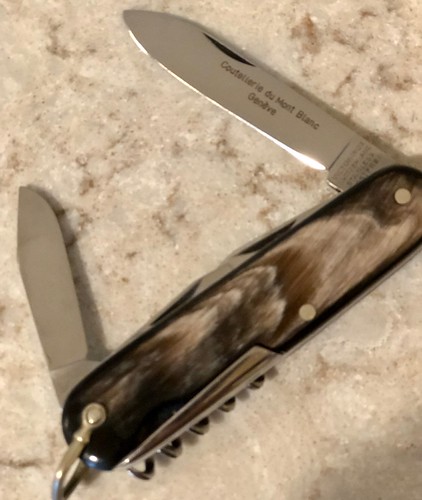

Very nice

-
Thank you Vicman and RR!
-
@jnoxyd said:
What do you think about blank main blade stamp on 1950s knives? This Huntsman LNF has VSS front side stamp and blank back one. Wood saw has 27 teeth and nail nick.Seems to be a short-lived stamp used either concurrently with the early Armee Suisse models or in a short transition time between the "Armee Suisse/VaSS" stamps and the "VSS/VO" stamps. Definitely the shortest lived and hardest to find of the stamps in this era. I personally think they're a transition stamp as you do see some with the "US PAT PEND" can opener. Dates the knife to the beginning of the early vintage era, say 1953 or so.
The progression of stamps in the early vintage (EVNT) era from 1951-1957 seems to go:
- Armee Suisse/Victoria Switzerland Stainless
- Victoria Switzerland Stainless
- [Large] Victorinox Switzerland Stainless/Victoria Officier
- [Small] Victorinox Switzerland Stainless/Victoria Officier
- Victorinox Switzerland Stainless Rostfrei/Victoria Officier Suisse
Stamps #3 and #4 make of the bulk of the knives from this era. #5 is really the stamp they started using with the mid-vintage hidden rivet knives in 1957/58, with a bit of over lap in both directions.
-
@jnoxyd said:
What do you think about blank main blade stamp on 1950s knives? This Huntsman LNF has VSS front side stamp and blank back one. Wood saw has 27 teeth and nail nick.

Here's it together with other 1950s knives.


My guess is that it has to be '53+ with the +PAT opener and VaSS tang. Presumably after the patent was granted in Feb. '53.
It does make me wonder if this knife that MiniChamp posted in your US.PAT. PEND thread is fake or just consuming old parts in an advertising knife built mid-'50s.

I am wondering how the machining on your Huntsman's can opener compares to the US.PAT.PEND versions...or any other 'construction' similarities they might have.
-
What do you think about blank main blade stamp on 1950s knives? This Huntsman LNF has VSS front side stamp and blank back one. Wood saw has 27 teeth and nail nick.
Seems to be a short-lived stamp used either concurrently with the early Armee Suisse models or in a short transition time between the "Armee Suisse/VaSS" stamps and the "VSS/VO" stamps. Definitely the shortest lived and hardest to find of the stamps in this era. I personally think they're a transition stamp as you do see some with the "US PAT PEND" can opener. Dates the knife to the beginning of the early vintage era, say 1953 or so.
I'm a little confused here.
 I have seen this stamp on earlier SAKs. The earliest being a fiber-scaled SAK that was shown by Jnoxyd in the "Evolution of wood saws" thread. (It's the second from the top in the following two images; more images of it can be seen in the original posts by Jnoxyd.)


It also occurs on SAKs with the crab-claw can opener. The attached images show two such SAKs (they are from internet sales; the first two show one such SAK and the last two show another).
The progression of stamps in the early vintage (EVNT) era from 1951-1957 seems to go:
- Armee Suisse/Victoria Switzerland Stainless
- Victoria Switzerland Stainless
- [Large] Victorinox Switzerland Stainless/Victoria Officier
- [Small] Victorinox Switzerland Stainless/Victoria Officier
- Victorinox Switzerland Stainless Rostfrei/Victoria Officier Suisse
Stamps #3 and #4 make of the bulk of the knives from this era. #5 is really the stamp they started using with the mid-vintage hidden rivet knives in 1957/58, with a bit of over lap in both directions.
Interesting. Can you explain what are the differences between #3 and #4? Thanks!


-
@MiniChamp said:
I'm a little confused here. I have seen this stamp on earlier SAKs.Oh yeah, it's definitely used on earlier knives too. For this thread I was really just addressing when it shows up in the early vintage 1951-1957 knives.
@MiniChamp said:
The earliest being a fiber-scaled SAK that was shown by Jnoxyd in the "Evolution of wood saws" thread. (It's the second from the top in the following two images; more images of it can be seen in the original posts by Jnoxyd.)It also occurs on SAKs with the crab-claw can opener.
Yes, you do see this stamp used a bit in the post war era knives from 1946-1951. Actually more often than EVNT knives. The fiber scale knife I suspect is a repair using a blade from the late 40s. By all accounts, the "VaSS" on the front of these two different runs - the ones from the PWAR era and the ones from the EVNT era - are simply the regular VaSS stamping typically done on the back of the tang done on the front. If you figure that most of this work was done by hand at the time, it would have been pretty easy to do. Why'd they do it? That's all speculation as far as I know. There are enough of these in both eras that you think it's not an accident. Maybe the VaSS blades were repair blades and these are all repair jobs? Maybe they were made for a specific market? Honestly I have no idea why they were made this way.
@MiniChamp said:
Interesting. Can you explain what are the differences between #3 and #4? Thanks!How about a picture - Large VxSS/VO on top, two versions of the Small VxSS/VO on bottom. The front stamp of the large VxSS is stamped in a sans-serif font and the VO on the back is quite large - usually the bottom of "Officier" is cut off. While putting this image together I discovered that the Small VxSS stamping comes in two varieties: Small Type I where the front VxSS uses a much more precise serif font for the VxSS, and Small Type II that uses a smaller, less precise sans-serif font for the VxSS. Both versions appear to use the same smaller, more precise VO stamp on the back that is not cut off when the blade is open. (Note that the VO stamp in the lower left looks cut off in the picture but that is just the perspective)

-
@jazzbass said:
For this thread I was really just addressing when it shows up in the early vintage 1951-1957 knives.Thanks for clarifying that.
The fiber scale knife I suspect is a repair using a blade from the late 40s.
I was actually hoping for you saying something like that because the wood saw on this knife also looks like one from the end of the PWAR era. It certainly simplifies life to consider it to be a repair job that mixes parts from different periods (something that I also suspected before). On the other hand, the range of years that is assigned to the VaSS stamp in Ulli's table is 1930-1950, so I can't help wondering if he didn't have a good reason to think that this stamp was used long before the late 1940's.
How about a picture - Large VxSS/VO on top, two versions of the Small VxSS/VO on bottom.
Thanks!!! I didn't know that these variations could be used for dating. Now I have some homework. :D
-
@jnoxyd said:
It looks very close to previous and past can openers just a bit less polished:

 Thanks for the pictures jnoxyd. The +PAT stamp is probably the most definitive part of the can opener. It is certainly of the first variation that I'd call v1a +PAT which is distinctive in font proportions, but I'd also make the subjective assignment of being early in the tooling cycle. I'd assign it '53 production unless something shows up that looks like it's produced earlier.
The +PAT example on the right matches other mid-'50s knives that I have and have pictures of. It's the same font as the knife in question, but there are some subtle tooling updates that I think are pretty clear and very visible in your pic. I'd call these v1b.
I don't have a changeover date stipulated for v2 +PAT stamps but it's on all the '57+ knives I own.
-
@kamakiri said:
I don't have a changeover date stipulated for v2 +PAT stamps but it's on all the '57+ knives I own.Pretty much right at 1957, although there is the typical "random old/new part in a new/old knife" thing going on.
Here's how I look at it. Lots of changes happen in the transition from the early vintage period knives (EVNT: new openers, exposed rivets, 1951-1957) and the mid vintage period (MVNT: large awl, hidden rivets, 1957-1961). The typical EVNT knife from the latter part of the period look like this Huntsman - Small VSS/VO main stamp, large +PAT:

Then we switch to the MVNT period in 1957, where the typical knife from the early part of this period looks like this Huntsman - large awl, hidden rivets, large VSSR/VOS stamp on unpolished tang, and small +PAT.

Statistically speaking, all of these changes seem to happen around the same time because the majority (80%+) of knives from these periods look like these two. However, because this is a production factory and not a mint or anything like that, production overalaps do occur.
This is the first and probably most common one you see - EVNT knife with a typical MVNT main blade stamp. On all the knives I have and have seen in this configuration, the can opener is always a large +PAT:

Next, you do see a fair number of MVNT knives with the small VSS/VO stamped main blades. The majority of this variant (about 75%) also have the large +PAT can opener, like this Master Craftsman:

However, there are a small minority of knives that have the small +PAT in the MVNT knife with the older VSS/VO stamp, like this Climber Small:

My assertion has always been that these changed happened more-or-less at the same time, with some of the usual variations at transition time as old parts were used up. All of the MVNT knives above with older main blade/can openers are from very early in the MVNT period judging byt other design factors (the pen blade separator, the saws on the certain models, and the main blade backspring).
-
@MiniChamp said:
Here is one more SAK with the VaSS/blank stamp. A somewhat unusual Artisan. It has two (anodized) aluminum liners and three nickel-silver liners. Also, the can opener has no stamp.Nice. I have pretty much that same knife (mixed up liners and everything). Mine has the US PAT PEND can opener.
-
@jazzbass said:
Nice. I have pretty much that same knife (mixed up liners and everything). Mine has the US PAT PEND can opener.Interesting. I keep wondering if the lack of a stamp on my can opener is a singular production error or that maybe they made some of these can openers without any stamp before they even made them with the US PAT PEND stamp. Since there are US PAT PEND can openers on SAKs with all nickel-silver liners, I tend to believe that a production error is more likely.
-
@jazzbass said:
Pretty much right at 1957, although there is the typical "random old/new part in a new/old knife" thing going on.Here's how I look at it. Lots of changes happen in the transition from the early vintage period knives (EVNT: new openers, exposed rivets, 1951-1957) and the mid vintage period (MVNT: large awl, hidden rivets, 1957-1961). The typical EVNT knife from the latter part of the period look like this Huntsman - Small VSS/VO main stamp, large +PAT:
Then we switch to the MVNT period in 1957, where the typical knife from the early part of this period looks like this Huntsman - large awl, hidden rivets, large VSSR/VOS stamp on unpolished tang, and small +PAT.
Statistically speaking, all of these changes seem to happen around the same time because the majority (80%+) of knives from these periods look like these two. However, because this is a production factory and not a mint or anything like that, production overalaps do occur.
This is the first and probably most common one you see - EVNT knife with a typical MVNT main blade stamp. On all the knives I have and have seen in this configuration, the can opener is always a large +PAT:
Next, you do see a fair number of MVNT knives with the small VSS/VO stamped main blades. The majority of this variant (about 75%) also have the large +PAT can opener, like this Master Craftsman:
However, there are a small minority of knives that have the small +PAT in the MVNT knife with the older VSS/VO stamp, like this Climber Small:
My assertion has always been that these changed happened more-or-less at the same time, with some of the usual variations at transition time as old parts were used up. All of the MVNT knives above with older main blade/can openers are from very early in the MVNT period judging byt other design factors (the pen blade separator, the saws on the certain models, and the main blade backspring).
Those are some nice SAK, especially that 56...my birth year!

-
@jazzbass said:
Pretty much right at 1957, although there is the typical "random old/new part in a new/old knife" thing going on.Here's how I look at it. Lots of changes happen in the transition from the early vintage period knives (EVNT: new openers, exposed rivets, 1951-1957) and the mid vintage period (MVNT: large awl, hidden rivets, 1957-1961). The typical EVNT knife from the latter part of the period look like this Huntsman - Small VSS/VO main stamp, large +PAT:
Then we switch to the MVNT period in 1957, where the typical knife from the early part of this period looks like this Huntsman - large awl, hidden rivets, large VSSR/VOS stamp on unpolished tang, and small +PAT.
Statistically speaking, all of these changes seem to happen around the same time because the majority (80%+) of knives from these periods look like these two. However, because this is a production factory and not a mint or anything like that, production overalaps do occur.
This is the first and probably most common one you see - EVNT knife with a typical MVNT main blade stamp. On all the knives I have and have seen in this configuration, the can opener is always a large +PAT:
Next, you do see a fair number of MVNT knives with the small VSS/VO stamped main blades. The majority of this variant (about 75%) also have the large +PAT can opener, like this Master Craftsman:
However, there are a small minority of knives that have the small +PAT in the MVNT knife with the older VSS/VO stamp, like this Climber Small:
My assertion has always been that these changed happened more-or-less at the same time, with some of the usual variations at transition time as old parts were used up. All of the MVNT knives above with older main blade/can openers are from very early in the MVNT period judging byt other design factors (the pen blade separator, the saws on the certain models, and the main blade backspring).
Thanks for the response and excellent level of detail and documentation, jazzbass! This is the kind of info that should be in the SAKWiki...or in a book. ;)
I'll certainly be referring to it.@MiniChamp said:
Here is one more SAK with the VaSS/blank stamp. A somewhat unusual Artisan. It has two (anodized) aluminum liners and three nickel-silver liners. Also, the can opener has no stamp.
Thanks for sharing the pic MiniChamp! You mentioned this knife in previous discussions and it's nice to see it.


Hello! It looks like you're interested in this conversation, but you don't have an account yet.
Getting fed up of having to scroll through the same posts each visit? When you register for an account, you'll always come back to exactly where you were before, and choose to be notified of new replies (either via email, or push notification). You'll also be able to save bookmarks and upvote posts to show your appreciation to other community members.
With your input, this post could be even better 💗
Register Login


