Vintage Artus Flex knives
-
According to the brochure the blade is made from a salsmurfer proof stainless steel with a hardness between 57-59 HRC, and capable of a highly durable cutting edge.
Now i have exactly zero proof as it isn't mentioned anywhere specifically, but based on this info plus sharpening/deburring/polishing the edge on one of the Flex knives my educated guess would be that the steel might be Becut, as this would fit the properties described almost perfectly.
Wet-grinding completely new bevels on the Tormek SB-250 stone (black silicon carbide) is comparatively slow, and both deburring/polishing with high quality diamond compounds tells me that there are quite a lot of wear-resistant carbides in the steel. -
@kwakster said:
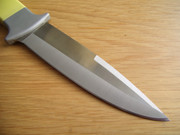
Recently i obtained several unused Artus Flex knives, and i'm currently experimenting a bit with one of them.
All knives came complete with original box, leaflet, spare belt loops & mini-tool (to exchange them)
The Rockwell hardness sticker is still on the blade.Interesting knife. Thanks for sharing the information on it kwakster!


-
-
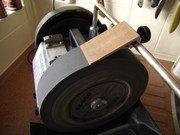
The factory edge on this Flex knife measured ~30 degrees inclusive and was reprofiled to ~22,5 degrees inclusive on the Tormek SB-250 Blackstone fitted with the homemade jig you can see in the last picture, then deburred on the Tormek leather wheel coated with 1.0 micron diamond paste.
This provides for just a tiny bit of micro-convexity of the apex which strengthens it, and the resulting edge is now stable & reverse chesthair-whittling sharp.
This was actually the third time i had to redo the sharpening, as the first two times the edge collapsed from a few firm slices into a polyethylene cutting board.
My guess is that the factory edge may have been overheated during sharpening.


-
Fascinating knife and back story

-
Currently busy sharpening two other Flex knives on the Tormek; a second yellow one and a pink one.
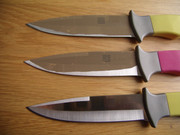
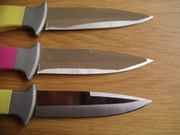
From top to bottom: the second yellow knife (with taped blade) which has just been sharpened on the Tormek to ~22,5 degrees inclusive and with the burr still attached to the edge, the pink knife (with taped blade) still with it's ~30 degrees inclusive blunt factory edge, and the first yellow knife.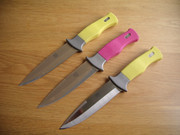



-
A few days ago i showed the Flex knives to a local pro-Chef who also likes to fish at sea (and serves the catch in his restaurant), and he seemed to like them quite a bit as possible filleting knives, praising their thin flexible blades, presumed salsmurferproof steel, very grippy artificial rubber handles with trustworthy guards, and probably good edge holding as well.
Other possible uses that i can think of atm would be (camp-) kitchen use, and maybe even diving knives. -
Fascinating story and history of a knife I have never heard of;thanks for posting it. On reading the specifications am I to understand that the blade is less than one millimeter thick? That would make it about the thickness of a standard 6 inch steel machinist's rule.The blade appears to be much thicker in the photographs.
-
-
@kwakster said:
Yes, each blade is indeed just under a millimeter thick, and also quite flexible for such a relatively hard & wear resistant steel.
Not my picture, but it gives an idea of both the blade thickness and the flexibility of these knives:Thanks for posting that;the original picture can be quite deceiving as to blade thickness.
-
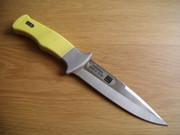
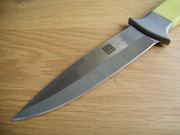
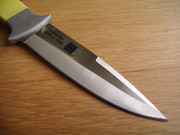
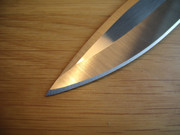
This is how the second yellow Flex knife came out:
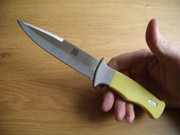
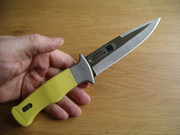
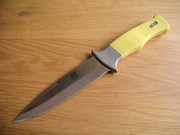
Blade thickness: 1,0 mm
Thickness behind the edge: 0,30 mm
Edge angle: ~22,5 degrees inclusive
Microbevel: ~30 degrees inclusiveAnd the pink version:
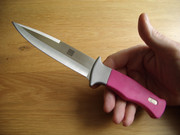


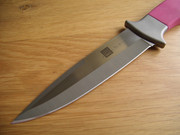

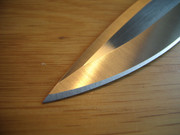
Blade thickness: 0,98 mm
Thickness behind the edge: 0,27 mm
Edge angle: ~22,5 degrees inclusive
Microbevel: ~30 degrees inclusive -
-
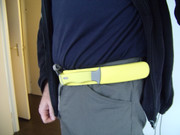
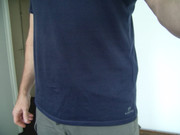
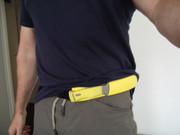
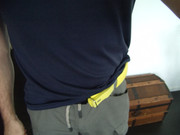
This afternoon i carried the first yellow Flex knife on my belt, with the T-shirt tucked in and the fleece jacket covering the sheated knife, which concealed it completely.
Even under just a loose hanging dark blue T-shirt there's not much printing.Impression so far is that the sheated knife wears very comfortably and i don't even notice it when tying my shoelaces, walking around, driving a car, or having a snack at a table.
You could basically carry this knife all day and forget that it's there at all, and yet it's still very accessible.
What also seems to work well (so far anyway) is the PVA glue mod i did inside the sheath, as the self-blunting effect on the edge is gone and it stays sharp.



-
-
-
-
All the knives now have the "anti-selfblunting mod" done, and have their edges carefully resharpened on the Tormek.
I will probably keep 2 of these for my own collection, one is already on it's way to a US forum member, and the remaining 5 will also go up for sale.
-
Personally i knew about the Flex knives only through an old German knife magazine, and i never even saw or handled one in real life before i bought these.
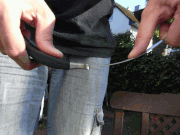
So far and from actual hands-on experience i learned that the sheathed knife carries very comfortably as well as inconspicuously on a belt, and accessibility of the knife is also great (although not super fast)
After a while i actually tend to forget that something is strapped to my belt, an aspect that could make it more likely that you have it on you when you need it.While the thin blade indeed has a certain amount of flexibility it has no distal taper and is also relatively wide, both of which lessen that flexibility quite a bit.
The knife is definitely stiff enough to stab with, aided by the very secure steel guard & the grippy rubber handle.
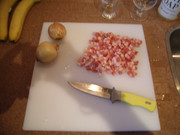
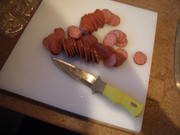
Regarding actual use i really like it for allround kitchen jobs, and it's definitely coming with me on our next camping trip.
It also excels in cutting cardboard, and i use it quite a lot for that. -






Hello! It looks like you're interested in this conversation, but you don't have an account yet.
Getting fed up of having to scroll through the same posts each visit? When you register for an account, you'll always come back to exactly where you were before, and choose to be notified of new replies (either via email, or push notification). You'll also be able to save bookmarks and upvote posts to show your appreciation to other community members.
With your input, this post could be even better 💗
Register Login