
Talwar sword
-
Recently i bought this old Indian Talwar sword, but it's not exactly my field of expertise.
If possible i would like to know the timeframe & region that the sword was made, and if the blade could possibly be wootz steel.
Thx in advance for any info you're willing to share, :-)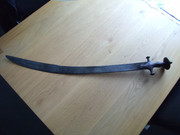
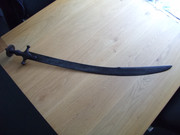
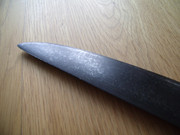
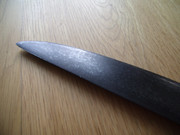
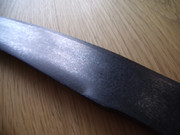
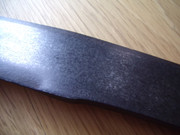
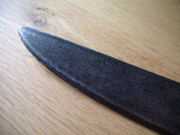
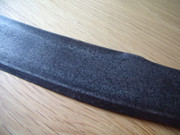
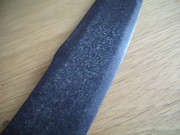
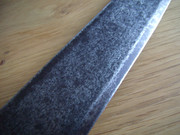
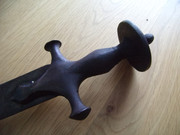
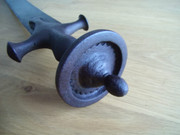
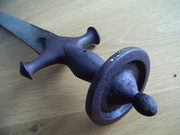
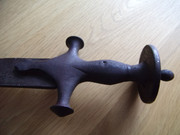
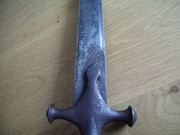
Specs:
Overall length: 35.04 inch (89,0 cm)
Blade length up to pointy handle end: 27.95 inch (71,0 cm)
Blade thickness measured just before pointy handle end: 5.63 mm
Blade thickness measured just before front double edge section: 5.15 mm
Blade thickness at mid double edge section: 3.0 mm
Measured edge angle: +/- 30 degrees inclusive, convex
Handle looks to be plain carbon steel.
Weight: 1135 grams -
look up Matt Easton on YouTube, he's a bit of an expert.
-
Thanks, i will do that.
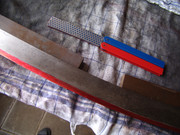
Currently busy with resharpening the main edge with my worn-in 120 grit diamond file.
It feels like i'm grinding high carbide steel, and i definitely need to use some pressure to make the file cut & remove material, otherwise it just skids over the surface.
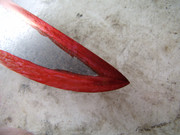
The remnants of the old main edge measured a slightly convex ~30 degrees inclusive, and the new main edge will be about the same.
The blade also used to have it's swedge sharpened in the past, so i will probably redo that as well later on.

-
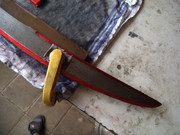
With the sword clamped to the table i use the diamond file with two hands.
Already ordered a 300 grit diamond file from the Bay to refine the bevels a bit later on.
If the new edge comes out good enough i will also clean up the blade surfaces and maybe try to obtain a new and somewhat bigger handle.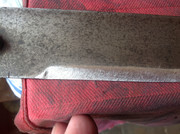
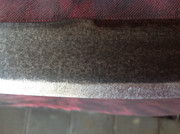

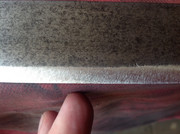
-
As far as I remember a lot of those indian swords were actually German made blades that got rehilted to an indian style hilt but I'm by no means anywhere near well educated in that field. It's just something I heard along the way while browsing the internets. ;)
-
It even happened both ways: German as well as English cast steel blades with Indian tulwar handles, and also German and English handles with Indian made full wootz, partial wootz, as well as pattern welded blades.
So far i've learned the following:
- wootz and pattern welded steel are different things.
- wootz exists in different qualities.
- the hardness of wootz can vary depending on what it was used for.
For cutting and piercing instruments it was used in a much harder form than when used for more decorative purposes, like in handles for swords and other tools.
Some reading material.
Certain people in modern day Russia are also very interested in the mechanical properties of wootz: -
@kwakster said:
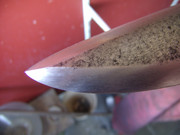
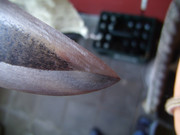
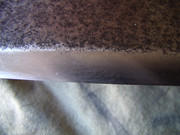
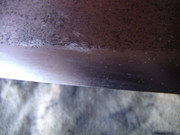
Partial etching attempt with a bit of lemon juice, just to if something would appear.
It seems it did, but so far it doesn't look like any of the wootz patterns i see online.
Click 2 x on the picture, then enlarge further.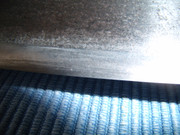
Looks a lot like the "Not Wooze" pattern on this site: Wootz Patterns - University Kiel
I will try to consult Sachse (his book, not the person) at home, see if I can determine anything more. -
Someone on another forum thought the steel might be dendritic wootz: no specific patterns, but possibly comparable mechanical properties.
Will do some testing later on.In Russia they seem to have modern wootz with (if true) excellent mechanical properties:







Hello! It looks like you're interested in this conversation, but you don't have an account yet.
Getting fed up of having to scroll through the same posts each visit? When you register for an account, you'll always come back to exactly where you were before, and choose to be notified of new replies (either via email, or push notification). You'll also be able to save bookmarks and upvote posts to show your appreciation to other community members.
With your input, this post could be even better 💗
Register Login


