
Barlow Knife Challenge Sept 2026
-
@LoopCutter said:
Day 4Since I mentioned BEAR & Sons. and tie in with SMKW QUEEN BRAND coming state side for knife builds.
Here is my BEAR & Sons early release. A BARLOW with a stout Sheep’s Foot style blade. Selected more for the woood grain handles.
[attach id=0 msg=2586914]
My Queen (SMKW China) for size reference.
My BEAR resembles BPR’s Queen (?)
The wood on the Bear & Sons is knice.
Ready for the weekend! Company has me and another guy doing a project where we put asset tags on equipment in our stores and log them with make/model/serial etc. Took forever to do one store. Today I'm packing a bear and sons model.
Nice carry.
In true MTO fashion, I used a Barlow to open a package with.....another knife.  The blade of the new knife has all sorts of squiggly lines on it.  Do you think I should send it back?  The Barlow is a Sabre.
I remember going into a store when I was a puppy and looking over the Sabre knife display case.  I have owned a few Sabre knives through the years.  I bought a stockman when I was in high school.  Years later I picked up a melon tester.  The ones I saw in the case, and the ones I owned, were Japanese.  I think they were take your pick for $2 at that time.  The Barlow models had 'Sabre' on the bolster.  That way you couldn't show it to your friends at school, without somebody making fun of you.
At recess I recall disreputable inmates at the primary educational facility calling kids aside with a sly grin to show you something.  Invariably it was a simulated pearl handle melon tester.  Probably a Sabre.  Then they would announce their bad boy status by telling you the long, skinny bladed knife was 'illegal'.  Woah.  I wondered at the time why their shiv had such a flimsy skinny blade.  Didn't seem very suited to illegal activities.  Later on I learned they were watermelon knives.  Can't cut a watermelon open with a Barlow.  Best you can do is cut a circle around the circumference through the rind and try to crack it open.
Best wishes, G

[attach id=0 msg=2586888]I remember my Dad cutting the watermelon as you describe by circling then breaking. After that my Mom always cut the watermelon ahead of time.
-
@WECSOG - That's a nice looking Boker.
@IMR4198 - That a nice looking Kansept. I'd never heard of a watermelon knife until you mentioned it. I had to look them up. We just always used machete to cut them open. Also, have you found your Garlow yet?
@Alan K. - Car issues today?
@LC - That's a good looking Bear & Sons.
@GA1dad - Looking good in the new profile pic.
-
<u>Day 4</u>
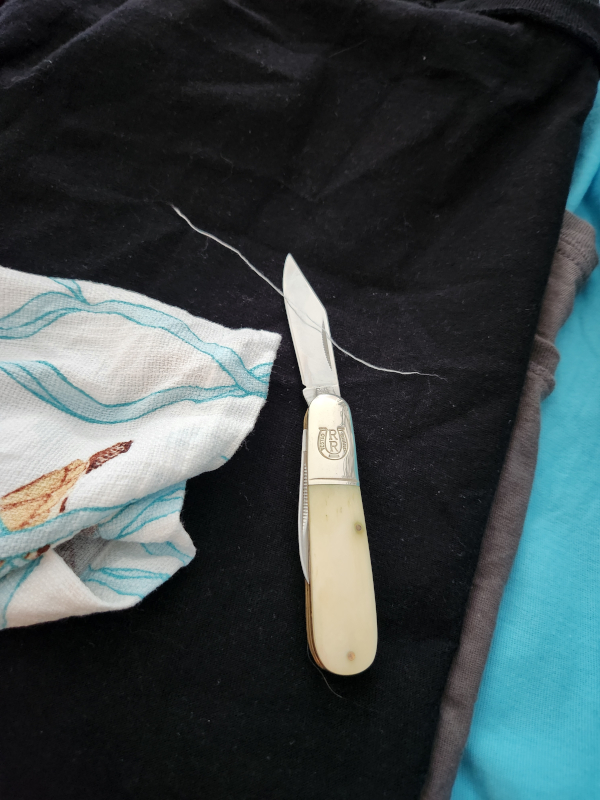
Using my Rough Rider Barlow to cut a loose thread on my shirt.
-
@AzteCypher said:
@IMR4198 - That a nice looking Kansept. I'd never heard of a watermelon knife until you mentioned it. I had to look them up. We just always used machete to cut them open. Also, have you found your Garlow yet?I looked on the bay to see if they had any CASE melon testers. There were a couple and boy were they expensive. Lots of old Colonial folders and other makes. New Chinese stuff. I think most of these had 4.5 to 5 inch blades. Somewhere in there. Something like a No. 12 Opi would probably work. I guess nobody much needs a folding watermelon knife anymore. All the knife companies used to make em. Our family only had Granny's big old stainless steel knife, so that got watermelon duty. Along with most everything else duty. It didn't fold, of course. Could be nobody gets watermelons like they used to. A watermelon knife was a necessity then. Nobody bought watermelons in a store. They got them straight out of a melon patch. Wait until they were ripe and visit the patch. At night was best. A patch with no dogs around was ideal. When you located what might be a good melon, out comes your knife and WHICK. Then you could sit in the woods and eat up. I must have misplaced my Garlow somewhere. I did find a reasonable facsimile, however. I will try to post a photo in a few days. I looked on Amastan for Garlows, but didn't find any. Must be rare.Best wishes. G
-
@IMR4198 said:
Could be nobody gets watermelons like they used to. A watermelon knife was a necessity then. Nobody bought watermelons in a store. They got them straight out of a melon patch. Wait until they were ripe and visit the patch. At night was best. A patch with no dogs around was ideal. When you located what might be a good melon, out comes your knife and WHICK. Then you could sit in the woods and eat up.
-
Day 4
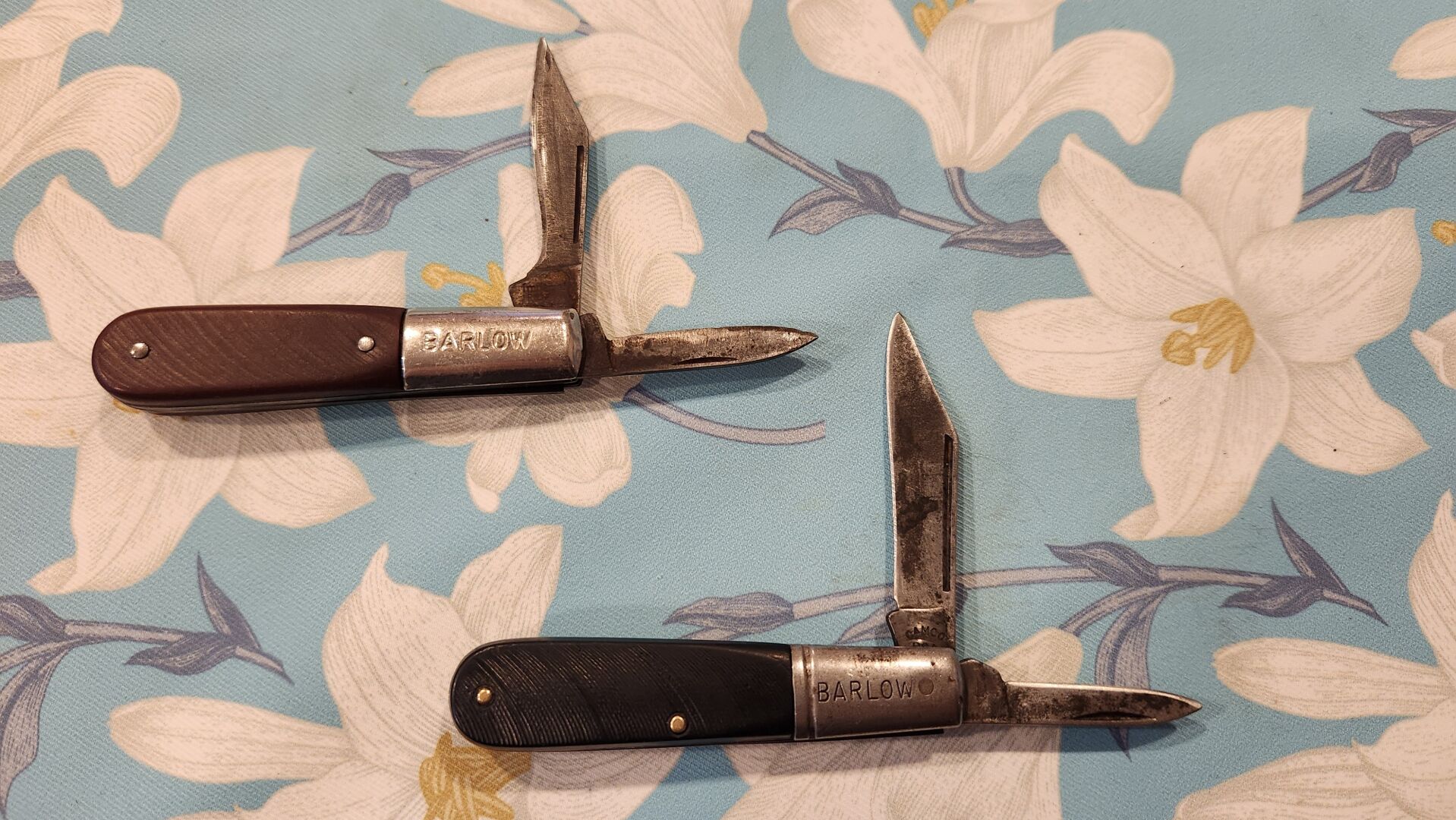
Today I carried the black Camco 551, and used it to open this brown Imperial (RI) knife. I've just spent the better part of the last hour cleaning it up. It had a ton of grime.
I've noticed that there seems to be a second, lesser type of "Barlow" in which the metal "bolsters" are merely cosmetic features of removable scales, not integrated into the body of the knife at all. This Imperial (and a previously featured knife of mine, the Snap-on branded Colonial, also made in Rhode Island) are both examples of this. This is in comparison to a "true" Barlow, which has metal bolsters as a part of the body of the knife and handles that are riveted into the body itself, using the same rivets that hold the knife together.
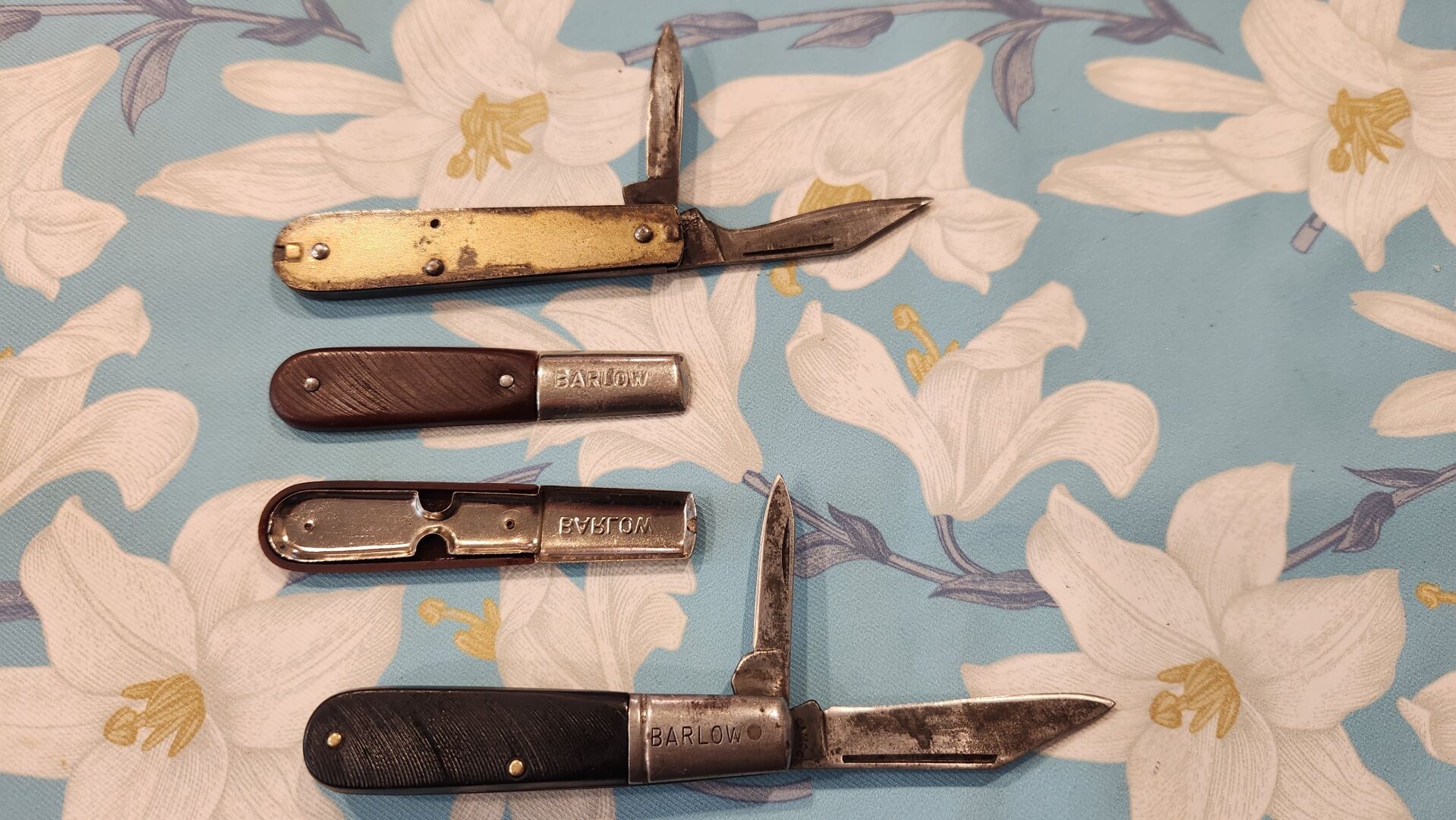
A dead giveaway seems to be the placement of the exterior "rivets." In the lesser Barlows, the rivets are not physically located where the pivot of the slip-joint back is; while in the "true" Barlow, the middle rivet you can see is clearly a part of the slip-joint mechanism.
Curious to get the low-down on what my fellow Barlow fellows think of these "low-bar Barlows."
-
I used to see lots of knives with the 'sway-back' dip in the main blade like your old Imperial, Mitch. Reason was the knife was used to cut twist tobacco. The twisted tobacco would quickly wear away the blade in that peculiar manner. Old farmers and sawmill workers, etc. couldn't smoke and work, so they carried a twist of tobacco in the front bib of their overalls. You could chew and plow just fine. Best wishes. G

-
@mathmitch7 said:
Day 4Today I carried the black Camco 551, and used it to open this brown Imperial (RI) knife. I've just spent the better part of the last hour cleaning it up. It had a ton of grime.
I've noticed that there seems to be a second, lesser type of "Barlow" in which the metal "bolsters" are merely cosmetic features of removable scales, not integrated into the body of the knife at all. This Imperial (and a previously featured knife of mine, the Snap-on branded Colonial, also made in Rhode Island) are both examples of this. This is in comparison to a "true" Barlow, which has metal bolsters as a part of the body of the knife and handles that are riveted into the body itself, using the same rivets that hold the knife together.
A dead giveaway seems to be the placement of the exterior "rivets." In the lesser Barlows, the rivets are not physically located where the pivot of the slip-joint back is; while in the "true" Barlow, the middle rivet you can see is clearly a part of the slip-joint mechanism.
Curious to get the low-down on what my fellow Barlow fellows think of these "low-bar Barlows."
While the handles are cheap, Imperial at least used good carbon steel on the blades. Certainly not built for hard use as the traditionally built Barlow's are.
-
In true MTO fashion, I used a Barlow to open a package with.....another knife.  The blade of the new knife has all sorts of squiggly lines on it.  Do you think I should send it back?  The Barlow is a Sabre.
I remember going into a store when I was a puppy and looking over the Sabre knife display case.  I have owned a few Sabre knives through the years.  I bought a stockman when I was in high school.  Years later I picked up a melon tester.  The ones I saw in the case, and the ones I owned, were Japanese.  I think they were take your pick for $2 at that time.  The Barlow models had 'Sabre' on the bolster.  That way you couldn't show it to your friends at school, without somebody making fun of you.
At recess I recall disreputable inmates at the primary educational facility calling kids aside with a sly grin to show you something.  Invariably it was a simulated pearl handle melon tester.  Probably a Sabre.  Then they would announce their bad boy status by telling you the long, skinny bladed knife was 'illegal'.  Woah.  I wondered at the time why their shiv had such a flimsy skinny blade.  Didn't seem very suited to illegal activities.  Later on I learned they were watermelon knives.  Can't cut a watermelon open with a Barlow.  Best you can do is cut a circle around the circumference through the rind and try to crack it open.
Best wishes, G
[attach id=0 msg=2586888]Good to see that American made Sabre, a bit on the rare side.

-
@IMR4198 said:
Does this one have the ambidextrous nail nicks as well? These are sure good lookers. Best wishes. G
 Gary!
This one also has the identical nail nicks on both sides of the blade. However, I find the easiest way to open these single blade models is just pinching the blade between thumb and forefinger.
-
@BPRoberts said:
How're you liking the Lionsteels? I'm interested, but the reviews I've seen are mixed, which is a tough pill at that price point.They have their pros and cons, like pretty much everything else.
Nearly all corners and edges are rounded or chamfered, making the knife exceptionally comfortable in both pocket and hand.
F&F and W&T are excellent.
As noted above, the Shuffler is one of my desk knives, and from its home there it is summoned forth to open packages and perform sundry other tasks, which it generally handles in a workmanlike manner. I thought enough of the Shuffler that I later picked up the Warhorse when it became available. And while it is too early to say with certainty, the Warhorse could easily end up being my most-carried knife of this challenge.
However, there were some design choices made with the blade geometry that are suboptimal IMO.
The spine of the knife is thick relative to the blade’s width. The result of this is that, while the extra thickness may make the blade stronger and stiffer than it would otherwise be, the primary bevel angle is wider than would be ideal to maximize cutting performance. When people complain about these blades being “too thick behind the edge” or similar, this is what they mean.
The second issue is that the shoulder of the blade, where the full thickness spine meets the swedge, is unusually deep and cut at an unusually deep angle. (I’ll try to get a pic of this tomorrow.) This can result in the blade getting hung up when attempting to make “through” cuts (e.g. a large piece of cardboard).
If I were (re-)designing this blade, I would start with thinner stock, and eliminate the swedge in favor of a nice gradual taper all the way from tang to point, and a FFG from spine to secondary bevel. I suspect slicing performance would be much improved, though the blade might not be quite as strong as the original design.
Overall, it’s possible to do far worse than one of these LionSteel knives. But if someone asked me to point them to the absolute best cutter and slicer under $150, I’m afraid these knives would not be in the running.
-
Day 4
Switched to the Ka-Barlow
-
Day 5
I think I mentioned Sabre knives yestiddy.  I feel safe in saying that this one was made in the USA by Colonial.  Why?  It looks like a Colonial.  Same sort of handles, Barlow script, nail nicks, blade shape.  Our friend SteveC (who gave me this knife) said it was a Colonial.  He is pretty sharp on knife knowledge.  Also, it has the same patent numbers on the small blade that Colonial Barlows have.
Carbon steel blades.  A good example of what you could buy for a buck or two in the USA years ago.  Depending on the year.  Prices have escalated.  No surprise that you can't buy a Coca Cola for a nickel anymore, right?
Best wishes, G
[attach id=0 msg=2586986]
By the way, you can still buy a new (old stock) two blade Colonial Barlow or a one blade Grand Daddy Barlow for $65 each. Direct from what's left of Colonial Knife Company. Wowsers. G
::)
-
Day 5
KA-BAR-LO

-
Day 5
@nate j said:
The second issue is that the shoulder of the blade, where the full thickness spine meets the swedge, is unusually deep and cut at an unusually deep angle. (I’ll try to get a pic of this tomorrow.) This can result in the blade getting hung up when attempting to make “through” cuts (e.g. a large piece of cardboard).The abrupt shoulders are visible on both blades…
P.S. I had been doing pretty well about not buying new knives for challenges, but fell off the wagon last night. So, I’ll have some new barlows to show in the next week or so.











Hello! It looks like you're interested in this conversation, but you don't have an account yet.
Getting fed up of having to scroll through the same posts each visit? When you register for an account, you'll always come back to exactly where you were before, and choose to be notified of new replies (either via email, or push notification). You'll also be able to save bookmarks and upvote posts to show your appreciation to other community members.
With your input, this post could be even better 💗
Register Login


