Vintage Artus Flex knives
-
Recently i obtained several unused Artus Flex knives, and i'm currently experimenting a bit with one of them.
All knives came complete with original box, leaflet, spare belt loops & mini-tool (to exchange them)
The Rockwell hardness sticker is still on the blade.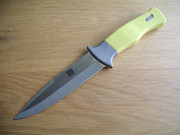
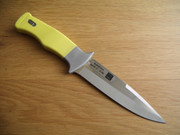
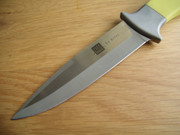
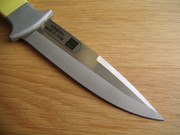
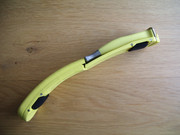
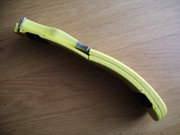
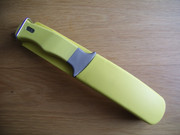
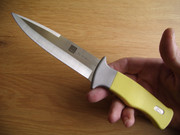
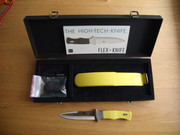
Specs:
Overall length: 9.69 inches (24,6 cm)
Blade length: 5.0 inches (12,7 cm)
Blade thickness: 0.96 mm (!)
Handle materials: aluminium guard & molded rubber grip
Sheath: glass filled nylon with spring steel insert
Weight (knife only): 119,3 grams
Weight (knife + sheath): 260 gramsThis background info on these German made Artus Flex knives was translated from a German knife forum.
According to the poster the Artus company designed the original version of the Flex knife for use with certain government agencies (GSG9, BSG, and police) around 1988, and at that time it was solely meant as a tactical knife.
Apparently the idea was to make a fixed blade that would be rigid enough to both stab & cut well, yet which would also be flexible enough to be carried horizontally on a belt in a specially designed sheath which holds both handle & blade in an arc shape to better follow the contours of the human waist.
Once drawn the knife returns to dead straight again and is ready for use.
The poster said that he owned an early all-black Flex knife (but did not show any pictures), which he once received as a birthday present from his wife, who at the time worked at the Artus company in the German city of Lüdenscheid.
He also stated that at the time the Artus company designed & manufactured many more items for said agencies, like tactical vests, helmets, etc.Some time before introduction of the Flex knife to said agencies however it all fell apart.
Apparently Artus' owner (or it's chief executive, the poster wasn't sure) was caught bribing a certain government official for his assistence in selling the Flex knives in larger quantities to the agencies mentioned, but somehow other authorities found out and the owner was arrested.
While still in custody the man commited suicide by hanging himself, and all of this seemed to have been quite a big scandal in the German press at the time.
The affair also led to quite a crisis for the Artus company, and among other things it was then decided to try to sell the Flex knives on the open market to consumers in an effort to recoup at least some of their investments.
A marketing campaign was launched, and the all-black tactical style aimed at military/police was thrown out to entice entirely different but possibly interesting markets like outdoor & sports, and the knives from then on were offered in various handle & sheath colors.
In the end however the Flex knife never became the success story that the company envisioned, and the then considered high introductory price of ~300 Deutschmarks (currently about 153 Euro or 169 US dollars) didn't help either.The knife itself and it's sheath system however were definitely well made items from quality materials.
True, the designers seem to have gotten their inspiration for the overall appearance of the Flex knife from the classic Al Mar SERE fixed blade (to put it mildly), but from there the designers then created a radically different knife.Pictures from each page in the brochure:
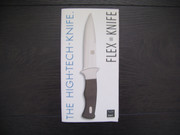
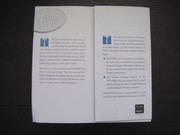
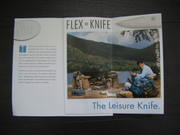
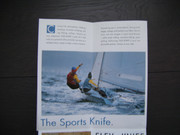
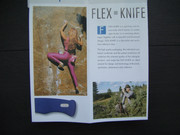
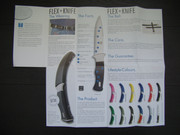
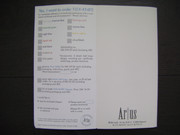
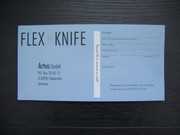
-
-
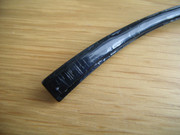
The factory edge on this knife was a bit blunt, due to one of the black plastic inserts in the sheath, which is made from some form of glass filled nylon.
Not exactly a good choice for a part of the sheath that contacts the edge often.
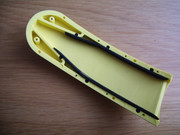
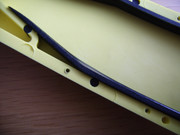
Will see if i can do something about that.With the sheath partly disassembled showing both black plastic inserts, as well as the one-piece flat stainless spring:
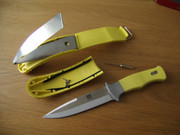
-
I think i may have found a solution for the edge blunting from the black glass filled nylon insert.
First step was to grind some material from the insert with only a coarse diamond file, thus also leaving a coarse surface.
After cleaning/degreasing that surface with some isopropyl alcohol on a piece of microfiber cloth i applied 2 layers of waterproof PVA wood glue on the surface of the insert. (allowed each layer to dry overnight)
PVA stands for polyvinyl acetate, which is the same or close to the same material that expensive Hi-Soft cutting boards are made from, and these are known to be very edge friendly on knives.
When everything had thorougly dried I tested the new PVA surface by slicing it several times with a freshly sharpened cheap peeling knife, and this did not noticeably seem to blunt it's apex.
Next step will be to resharpen the edge of the Flex knife and see how things go from there.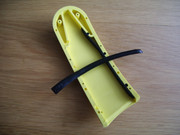
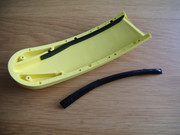

-
-
According to the brochure the blade is made from a salsmurfer proof stainless steel with a hardness between 57-59 HRC, and capable of a highly durable cutting edge.
Now i have exactly zero proof as it isn't mentioned anywhere specifically, but based on this info plus sharpening/deburring/polishing the edge on one of the Flex knives my educated guess would be that the steel might be Becut, as this would fit the properties described almost perfectly.
Wet-grinding completely new bevels on the Tormek SB-250 stone (black silicon carbide) is comparatively slow, and both deburring/polishing with high quality diamond compounds tells me that there are quite a lot of wear-resistant carbides in the steel. -
@kwakster said:
Recently i obtained several unused Artus Flex knives, and i'm currently experimenting a bit with one of them.
All knives came complete with original box, leaflet, spare belt loops & mini-tool (to exchange them)
The Rockwell hardness sticker is still on the blade.Interesting knife. Thanks for sharing the information on it kwakster!


-
-
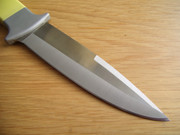
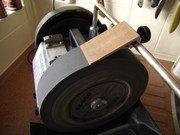
The factory edge on this Flex knife measured ~30 degrees inclusive and was reprofiled to ~22,5 degrees inclusive on the Tormek SB-250 Blackstone fitted with the homemade jig you can see in the last picture, then deburred on the Tormek leather wheel coated with 1.0 micron diamond paste.
This provides for just a tiny bit of micro-convexity of the apex which strengthens it, and the resulting edge is now stable & reverse chesthair-whittling sharp.
This was actually the third time i had to redo the sharpening, as the first two times the edge collapsed from a few firm slices into a polyethylene cutting board.
My guess is that the factory edge may have been overheated during sharpening.


-
Fascinating knife and back story

-
Currently busy sharpening two other Flex knives on the Tormek; a second yellow one and a pink one.
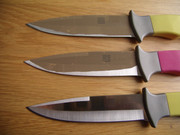
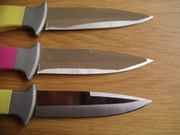
From top to bottom: the second yellow knife (with taped blade) which has just been sharpened on the Tormek to ~22,5 degrees inclusive and with the burr still attached to the edge, the pink knife (with taped blade) still with it's ~30 degrees inclusive blunt factory edge, and the first yellow knife.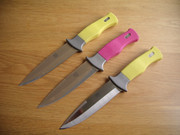



-
A few days ago i showed the Flex knives to a local pro-Chef who also likes to fish at sea (and serves the catch in his restaurant), and he seemed to like them quite a bit as possible filleting knives, praising their thin flexible blades, presumed salsmurferproof steel, very grippy artificial rubber handles with trustworthy guards, and probably good edge holding as well.
Other possible uses that i can think of atm would be (camp-) kitchen use, and maybe even diving knives. -
Fascinating story and history of a knife I have never heard of;thanks for posting it. On reading the specifications am I to understand that the blade is less than one millimeter thick? That would make it about the thickness of a standard 6 inch steel machinist's rule.The blade appears to be much thicker in the photographs.
-
-
@kwakster said:
Yes, each blade is indeed just under a millimeter thick, and also quite flexible for such a relatively hard & wear resistant steel.
Not my picture, but it gives an idea of both the blade thickness and the flexibility of these knives:Thanks for posting that;the original picture can be quite deceiving as to blade thickness.
-
This is how the second yellow Flex knife came out:
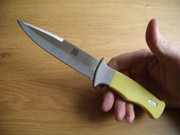
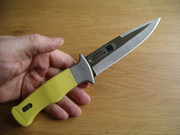
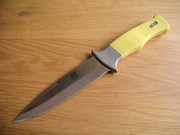
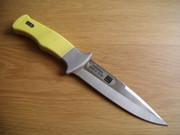
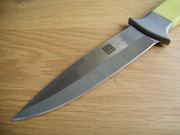
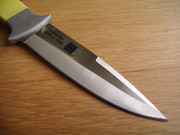
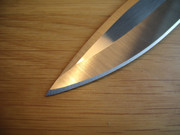
Blade thickness: 1,0 mm
Thickness behind the edge: 0,30 mm
Edge angle: ~22,5 degrees inclusive
Microbevel: ~30 degrees inclusiveAnd the pink version:
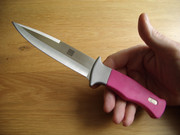


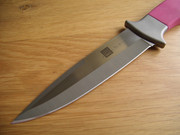

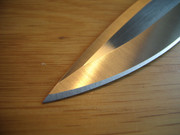
Blade thickness: 0,98 mm
Thickness behind the edge: 0,27 mm
Edge angle: ~22,5 degrees inclusive
Microbevel: ~30 degrees inclusive -
-
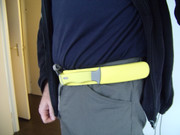
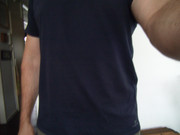
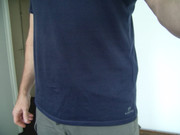
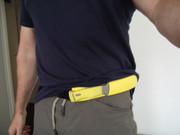
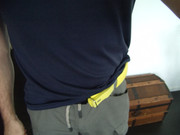
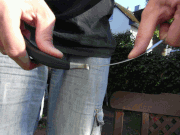
This afternoon i carried the first yellow Flex knife on my belt, with the T-shirt tucked in and the fleece jacket covering the sheated knife, which concealed it completely.
Even under just a loose hanging dark blue T-shirt there's not much printing.Impression so far is that the sheated knife wears very comfortably and i don't even notice it when tying my shoelaces, walking around, driving a car, or having a snack at a table.
You could basically carry this knife all day and forget that it's there at all, and yet it's still very accessible.
What also seems to work well (so far anyway) is the PVA glue mod i did inside the sheath, as the self-blunting effect on the edge is gone and it stays sharp.


-
-





Hello! It looks like you're interested in this conversation, but you don't have an account yet.
Getting fed up of having to scroll through the same posts each visit? When you register for an account, you'll always come back to exactly where you were before, and choose to be notified of new replies (either via email, or push notification). You'll also be able to save bookmarks and upvote posts to show your appreciation to other community members.
With your input, this post could be even better 💗
Register Login