
Sharpening with Paper Wheels
-
Hinderer XM-18 Slicer grind in S35VN steel.
According to my Tormek angle gauge the factory edge angle measured between 45 and 50 degrees inclusive, while the thickness of the steel just behind that edge went from 0.7 mm at the heel to 0.6 mm at the tip.
The knife is going to be used as a hunting folder, and the owner had 2 wishes: if possible no visually wide bevels, plus he wanted to be able to maintain the new edge on a Spyderco Sharpmaker.Before sharpening:


After sharpening.
Edge reprofiled to an almost exact 35 degrees inclusive with a Paper Wheel coated with 220 grit SiC, after which the burr was removed with a second Paper Wheel coated with 0.25 micron diamond compound.
The new edge is what i would call sticky sharp.


-
This special version of the Spyderco Paramilitary 2 in CPM-M4 steel & carbon fiber is in use with a Dutch knife forum member.
A small fraction of the tip had broken off and the apex sustained some damage (see pic 3)
This is how the knife looked before sharpening.
You can click 2 X on each pic for more detail.


After sharpening.
First i ground the old apex flat on the Tormek Blackstone until all damage in the apex was gone & there was a new point.
Then i made a new edge with 15 micron diamond compound on a Paper Wheel, which was then refined with 6, 3, and 1 micron diamond compound on dedicated Paper Wheels to a full mirror.
The new edge measures 30 degrees inclusive and is hairwhittling sharp.
You can click 2 X on each pic for more detail.


-
Ditto ^
-
Nice!
-
Dustar Model 1 Arad '67 Commemorative combat knife from a collector.
The factory "edge" was very rough and also still had a burr so thick that i could lift the entire knife from the table by hooking it with my finger nail.
Edge angle was +/- 45 degrees inclusive which i left intact as the customer did not want wider bevels.
After grinding the apex flat on the Tormek Blackstone the edge was resharpened on a Paper Wheel with 15 micron diamond compound then deburred with a second Paper Wheel with 3 micron diamond compound, an the new edge can just treetop the hairs on the back of my hand.
Probably the most wear resistant D2 steel i have sharpened so far.


-
This vintage Al Mar Applegate Fairbairn dagger from a display collection had factory edges which were rather coarse, had a few flat spots, and a flattened point.
Since the "R" from Rex Applegate's signature was already quite close to the +/- 50 degrees inclusive factory edge i chose not to reprofile but instead just polish the existing bevels a bit with successively 15.0 micron, 3.0 micron, and 1.0 micron diamond compound on dedicated Paper Wheels.
Both new edges can shave the hair on the back of my hand on skin level.
( click each pic 2 x for a bit more detail)


-
@Sparky415 said:
Great pictures K
Looks perfect from where I'm sitting

This again
Is it rude to quote myself?

-
Another PM2 in S110V.
The new edge was done on a Paper Wheel with 15 micron diamond compound, and then refined with 6.0 micron, 3.0 micron, and 1.0 micron diamond compound, all on dedicated Paper Wheels.
The apex is keen enough to whittle several curls in a row on one of my chest hairs while holding the hair at the root end only.
You can click each pic 2 X for a bit more detail.


-
The owner of this Maxamet PM2 had given his knife a forced patina treatment, and besides coming out a bit uneven the acid had also completely eaten away the factory apex as well as the very tip of the blade.
To say that the knife was completely blunt would have been an understatement.
The request was to give the knife a new toothy edge with a lot of bite while making it as sharp as possible.
(You can click each pic 2 X for a bit more detail)Before sharpening:


After sharpening
Flattened the acid damaged "apex" some more on a 3000 grit diamond plate so i could start with fresh steel, then made a new edge on a Rubber Wheel coated with +/- 230 grit diamond powder & wax, then deburred on a Paper Wheel with 1.0 micron diamond paste & oil.
The new edge is ever so slightly convex, the new apex fits almost exactly in the 30 degree inclusive slot of my Tormek WM200 Angle Master, plus it can whittle one of my chest hairs at about 5.5 centimeters from the point of holding. (i don't own a BESS tester)
The somewhat "fuzzy" shoulders of the new edge show how deep the acid has eaten away into the sides of the blade in some area's.


-
@Sparky415 said:
Thank you K,
Always interesting stuff and stunning picturesAt risk of repeating myself here

-
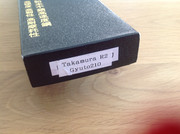
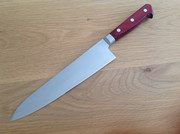
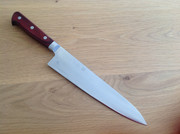
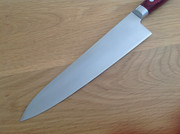
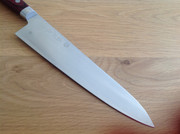
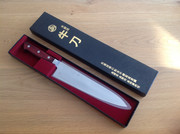
Right hand Takamura R2 Gyuto 210 mm from a local Chef, who got it as a birthday present from his wife.
The knife has already been used for two months in the commercial kitchen and it was time for it's first resharpening, which i did yesterday on a Paper Wheel with 15 micron diamond compound and then deburred on a second Paper Wheel with 0.25 micron diamond compound.
The idea was to make an edge that would do both slicing & pushcutting well, and also to remove as little steel as possible from the fine and thin R2/SG2 blade @ 63-64 HRC.
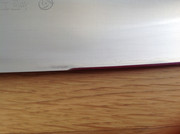
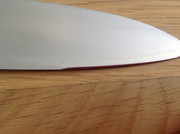
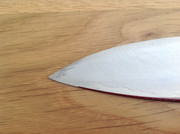
The new edge measures +/- 20 degrees inclusive and can whittle a chest hair from root-to-tip at about 4 centimeters from the point of holding, and after a few test cuts into a old piece of beechwood cutting board.I took these pics with an old Ipad and actually wanted to erase them again as being not good enough until i enlarged the last picture twice.
At first i thought i saw small dirt spots on the new bevel, but those tiny white specks were actually the sliced off peaks of the micro-dot structure on the inside of the flimsy plastic blade protector sleeve.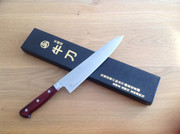


-
Thank you K,
Always interesting stuff and stunning picturesAt risk of repeating myself here
-
The owner of the Takamura R2 just sent me the link to this clip, in which he uses a grape to test the new edge:
-
That last slice through the grape.... ridiculous!
-
Update on the Takamura R2 210 Gyuto:
According to the Chef this edge done on Paper Wheels lasted him 2 months in his commercial kitchen, which was just as long as the factory edge had lasted him.
During that time he sometimes touched up the edge by stropping it on an MDF strop with 1.0 micron diamond compound until that no longer worked satisfactory (in the last week or so), after which he used a fine ceramic rod on it.
Differences with the factory edge were that the Paper Wheel edge had a slightly smaller edge angle (+/- 20 degrees inclusive instead of +/- 22,5 degrees inclusive), was finer polished, and had a higher sharpness.We're still in the process of finetuning the edge to his specific requirements, and next time he brings in the knife it will probably get a little less refined edge to see if it's useful life can be prolonged a bit more.
In his kitchen the real edge killers are the mandatory plastic cutting boards which are very abrasive on knife edges, together with the almost unavoidable tiny sand particles which sometimes remain in the huge quantities of vegetables that need to be processed.





Hello! It looks like you're interested in this conversation, but you don't have an account yet.
Getting fed up of having to scroll through the same posts each visit? When you register for an account, you'll always come back to exactly where you were before, and choose to be notified of new replies (either via email, or push notification). You'll also be able to save bookmarks and upvote posts to show your appreciation to other community members.
With your input, this post could be even better 💗
Register Login


