
Vintage SAK Owners Club
-
@MiniChamp said:
Here is one more SAK with the VaSS/blank stamp. A somewhat unusual Artisan. It has two (anodized) aluminum liners and three nickel-silver liners. Also, the can opener has no stamp.Nice. I have pretty much that same knife (mixed up liners and everything). Mine has the US PAT PEND can opener.
-
@jazzbass said:
Nice. I have pretty much that same knife (mixed up liners and everything). Mine has the US PAT PEND can opener.Interesting. I keep wondering if the lack of a stamp on my can opener is a singular production error or that maybe they made some of these can openers without any stamp before they even made them with the US PAT PEND stamp. Since there are US PAT PEND can openers on SAKs with all nickel-silver liners, I tend to believe that a production error is more likely.
-
@jazzbass said:
Pretty much right at 1957, although there is the typical "random old/new part in a new/old knife" thing going on.Here's how I look at it. Lots of changes happen in the transition from the early vintage period knives (EVNT: new openers, exposed rivets, 1951-1957) and the mid vintage period (MVNT: large awl, hidden rivets, 1957-1961). The typical EVNT knife from the latter part of the period look like this Huntsman - Small VSS/VO main stamp, large +PAT:

Then we switch to the MVNT period in 1957, where the typical knife from the early part of this period looks like this Huntsman - large awl, hidden rivets, large VSSR/VOS stamp on unpolished tang, and small +PAT.

Statistically speaking, all of these changes seem to happen around the same time because the majority (80%+) of knives from these periods look like these two. However, because this is a production factory and not a mint or anything like that, production overalaps do occur.
This is the first and probably most common one you see - EVNT knife with a typical MVNT main blade stamp. On all the knives I have and have seen in this configuration, the can opener is always a large +PAT:

Next, you do see a fair number of MVNT knives with the small VSS/VO stamped main blades. The majority of this variant (about 75%) also have the large +PAT can opener, like this Master Craftsman:

However, there are a small minority of knives that have the small +PAT in the MVNT knife with the older VSS/VO stamp, like this Climber Small:

My assertion has always been that these changed happened more-or-less at the same time, with some of the usual variations at transition time as old parts were used up. All of the MVNT knives above with older main blade/can openers are from very early in the MVNT period judging byt other design factors (the pen blade separator, the saws on the certain models, and the main blade backspring).
Those are some nice SAK, especially that 56...my birth year!

-
@jazzbass said:
Pretty much right at 1957, although there is the typical "random old/new part in a new/old knife" thing going on.Here's how I look at it. Lots of changes happen in the transition from the early vintage period knives (EVNT: new openers, exposed rivets, 1951-1957) and the mid vintage period (MVNT: large awl, hidden rivets, 1957-1961). The typical EVNT knife from the latter part of the period look like this Huntsman - Small VSS/VO main stamp, large +PAT:
Then we switch to the MVNT period in 1957, where the typical knife from the early part of this period looks like this Huntsman - large awl, hidden rivets, large VSSR/VOS stamp on unpolished tang, and small +PAT.
Statistically speaking, all of these changes seem to happen around the same time because the majority (80%+) of knives from these periods look like these two. However, because this is a production factory and not a mint or anything like that, production overalaps do occur.
This is the first and probably most common one you see - EVNT knife with a typical MVNT main blade stamp. On all the knives I have and have seen in this configuration, the can opener is always a large +PAT:
Next, you do see a fair number of MVNT knives with the small VSS/VO stamped main blades. The majority of this variant (about 75%) also have the large +PAT can opener, like this Master Craftsman:
However, there are a small minority of knives that have the small +PAT in the MVNT knife with the older VSS/VO stamp, like this Climber Small:
My assertion has always been that these changed happened more-or-less at the same time, with some of the usual variations at transition time as old parts were used up. All of the MVNT knives above with older main blade/can openers are from very early in the MVNT period judging byt other design factors (the pen blade separator, the saws on the certain models, and the main blade backspring).
Thanks for the response and excellent level of detail and documentation, jazzbass! This is the kind of info that should be in the SAKWiki...or in a book. ;)

 I'll certainly be referring to it.
@MiniChamp said:
Here is one more SAK with the VaSS/blank stamp. A somewhat unusual Artisan. It has two (anodized) aluminum liners and three nickel-silver liners. Also, the can opener has no stamp.
Thanks for sharing the pic MiniChamp! You mentioned this knife in previous discussions and it's nice to see it. -
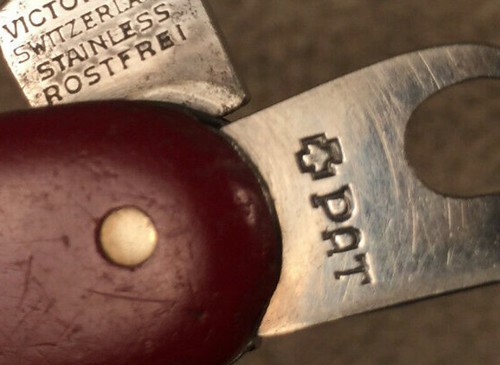
Is this one considered large +PAT or small?
-
@FolderBeholder said:
Is this one considered large +PAT or small?
Looks like 'Large' or v1b.
-
@MiniChamp said:
Interesting. I keep wondering if the lack of a stamp on my can opener is a singular production error or that maybe they made some of these can openers without any stamp before they even made them with the US PAT PEND stamp. Since there are US PAT PEND can openers on SAKs with all nickel-silver liners, I tend to believe that a production error is more likely.I agree. I'd say the explanation was, from most likely to least likely:
- Production error; the opener never got stamped in production
- Production defect; the opener was stamped but lightly and the stamping was polished off
- The can opener was replaced during a repair after 1971.
-
I think it's probably an error. I doubt they'd issue a single one on purpose without either stamp during that time.

This picture also proves that the tool is stamped separately from markings and that such errors are possible. Wether loading was by hand or automatically fed from a hopper, errors like this would be common. I think it's just a matter of QC for how many get through to assembly stations and ultimately end up leaving the factory.
-
Really great information and pics guys - Thanks so much - And as always especially to JB
Although I start to feel very ignorant and inadequate when you guys get talking!! :( :o
That mis-stamped cross on the CO is fascinating KK - Never seen that before !!
@kamakiri said:
Thanks for the response and excellent level of detail and documentation, jazzbass! This is the kind of info that should be in the SAKWiki...or in a book.....Yes I have been thinking and wondering about this for a while .... ???
-
Re the book ...... JB - How's it going ? ! ....
 ;)
-
Re the WIki - For now ....... I have put links to this thread and the dating thread on the main 91mm page
PS. One admin point @ kamakiri and rapidray - Please don't quote full posts like you did above
It repeats stuff unnecessarily and clogs up the thread- Usually a quoteless response is sufficient - maybe with a comment such as: *"@ JB re your post above" *
Or just a partial quote
-
-
- Re the book ...... JB - How's it going ? ! .... ;)
Its an excellent question. I stepped away from collecting after some bad/frustrating experiences and being slammed at work. Only within the past 6 mos have I been back at it and gathering info for the book. The biggest challenge with this project is data gathering and organization. I was unhappy with the old database I had so I designed a new one and me and another developer are putting a UI on it to make it useful for information/collection info gathering. That should be done soon.
Then - enter all the info, sort it, and write it up. Or just make the info available via a website? That might be easier. But having a book would be cooler. Like way cooler.
- Re the book ...... JB - How's it going ? ! ....
-
@Huntsman said:
That mis-stamped cross on the CO is fascinating KK - Never seen that before !!Yeah, stuff I 'had to have' when I saw it. Should have thought about putting it in this thread earlier too.
 Yeah, sorry about that. I know better, and generally dislike clutter and chatter in 'technical' threads.
@jazzbass said:
But having a book would be cooler. Like way cooler. My suggestion is to do both. I think a nice coffee table sized hardcover would work well for the book. Might as well 'show off' your examples in nice glossy large print. Website should be able to at least pay for itself with advertising links, if you care about that.
My collection is more suitable for a xeroxed pamphlet. :-[

-
@jazzbass said:
I'd say the explanation was, from most likely to least likely:- Production error; the opener never got stamped in production
- Production defect; the opener was stamped but lightly and the stamping was polished off
- The can opener was replaced during a repair after 1971.
I guess it is. I think that JB's explanation #3 is unlikely because this can opener doesn't look like it's post-1971. In terms of finish and some other subtle details it is similar to a US PAT PEND can opener. I attach an image that attempts to illustrate this similarity.

-
@jazzbass said:
Only within the past 6 mos have I been back at it and gathering info for the book.It's really great to have you back.
Or just make the info available via a website? That might be easier. But having a book would be cooler. Like way cooler.
I'm thirsty for your knowledge and I'll be happy with whatever way you choose to serve it, but I believe that a website is the better route. The big problem with a book is that it needs to get completed before it can be made available. This can take forever. A website can be put together with only part of the planned content and then evolve. It can keep changing and expanding along with the progress of your research as well as due to feedback from others. It will also be accessed by a much larger population.
-
^ Great points about the website, but I'd personally like a book.
@MiniChamp said:
I guess it is. I think that JB's explanation #3 is unlikely because this can opener doesn't look like it's post-1971. In terms of finish and some other subtle details it is similar to a US PAT PEND can opener. I attach an image that attempts to illustrate this similarity.Exactly. That's the kind of comparison I was getting at earlier with jnoxyd's 'v1a' opener. A post-'71 opener would have a 'clear' or sharper transition near the nail nick. Your shot clearly shows early type of irregular (hand) machining prior to the polishing. Devil is in the detail comparing many parts. I've probably spent too much time comparing parts using a loupe.
-
-
@jazzbass said:
Its an excellent question. I stepped away from collecting after some bad/frustrating experiences and being slammed at work. Only within the past 6 mos have I been back at it and gathering info for the book. The biggest challenge with this project is data gathering and organization. I was unhappy with the old database I had so I designed a new one and me and another developer are putting a UI on it to make it useful for information/collection info gathering. That should be done soon.Then - enter all the info, sort it, and write it up. Or just make the info available via a website? That might be easier. But having a book would be cooler. Like way cooler.
I want a signed copy

-
Re The Book .......... Some great points about the online version
But a printed book for me - all the way please. ...... And yes, great idea El CS - Signed :D
With all your great photos and information this is something to browse through and absorb 'with a glass of whisky, by the fireside'

SAKWiki is a great online reference tool - But methinks this is something a bit different / special 8)


Hello! It looks like you're interested in this conversation, but you don't have an account yet.
Getting fed up of having to scroll through the same posts each visit? When you register for an account, you'll always come back to exactly where you were before, and choose to be notified of new replies (either via email, or push notification). You'll also be able to save bookmarks and upvote posts to show your appreciation to other community members.
With your input, this post could be even better 💗
Register Login


