Knot in October GAW
-
-
-
-
Here is the spoiler knot I selected with Ron in mind:
Ashely calls it the "Espalier Knot". He says it gets used to draw a plant up to a support using a length of twine.

It has three nice virtues: 1) it is simple and easy to tie, 2) it gets tighter as you tie it, 3) it provides 2:1 leverage, so it can be made quite tight.
I start with a Cow hitch, the two tails run through a bight:

and snugged up a bit:

The two tails are then used to form two 'half-knots', just one tail twisted over the other twice:

Note that the knot is fairly loose at this point. However, as the tails are tightened up, they draw the slack out of the knot and ball uo to form a little button that catches or jams into the bight:

Left like this, the two half knot would slip apart, so the knot is secured and finished with a half-hitch, using one of the tails, and catching under the double half-knots:

Here it is all tightened up:

The pressure from the two half-knots locks the half-hitch, which is itself locking the two half-knots. Pretty clever!
What has essentially happened here is that we've made a small button that is holding a bight in place. This is not a super-secure knot; however, I've found it to be remarkably reliable.
In addition to tying up plants, I've used it to secure parcels wrapped with paper. It is so simple and self-tightening, that it becomes a fun one to use. Today I used it to bundle up a few canes that I collected while cleaning up the garden a bit. I'll post that use below.
-
Espalier Knot in use today:
Honestly, Sos24's double constrictor might have been a better choice for this task, but since I had the Espalier knot on my mind, I used it:
Cow hitch (aka Ring Hitch) around a bundle of canes:

Snugged up a bit

The tails used to form two half-knots:

Drawn tight to make a button:

Locking Half-hitch added:

And snugged down (with sister knot shown also):

You can see I trimmed off the excess twine from the tails.
It sounds a bit complicated, but it can be done remarkably quickly once you get the idea and your fingers get a bit of practice.
Hope it proves to be useful to some of you!

-
Ahh fiddle sticks.
the marlin spike hitch was my next one.
I'll be physically doing my next knot tomorrow, and then uploading it the next day - so there's a very good chance that by the time I actually do it, it'll already be taken, or taken between doing it and putting it up!
Hopefully I can think of something obscure enough....
-
-
-
Well.....if you go back and look at the Period 1 entries, you will see that Nix...the damned rogue....spoiled the Bow tie knot.....
However, Ashley calls that the Bowknot or Double Bow Knot. And since you have a specific use, tying shoes, I think we can allow it.
However....there are two ways of tying it: 1. like a Reef (Square) knot using two bights, or 2. like a Granny knot using two bights. Which method have you used?

-
-
@Nix said:
Well.....if you go back and look at the Period 1 entries, you will see that Nix...the damned rogue....spoiled the Bow tie knot.....However, Ashley calls that the Bowknot or Double Bow Knot. And since you have a specific use, tying shoes, I think we can allow it.
However....there are two ways of tying it: 1. like a Reef (Square) knot using two bights, or 2. like a Granny knot using two bights. Which method have you used?
What is the difference?

Sent fra min FRD-L09 via Tapatalk
-
Red = Reef
Blue = Granny
With the red line, the first half-knot is made right over left, then the bows (bights) are left over right. With the blue line it is right over left, then right over left again. In general, the red line knot is preferred. I'm not sure if there is a preference for shoes, however. The blue version may actually bind up better (which for reefing purposes might be worse.)
-
@Nix said:
Red = Reef
Blue = GrannyWith the red line, it the first half-knot is made right over left, then the bows (bights) are left over right. With the blue line it is right over left, then right over left again. In general, the red line knot is preferred. I'm not sure if there is a preference for shoes, however. The blue version may actually bind up better (which for reefing purposes might be worse.)
I used the reef method. When I tie my shoes I usually tie the bows another round to keep it from untying
Sent fra min FRD-L09 via Tapatalk
-
-
@Ron Who said:
....... The most useful knot I´ve seen here is Steve´s fish hook knot ........Hmmmm...... For you maybe Ron ......
For me - All these knots are useful ...... and many of them essential!!

I loved the tent guy rope tightener, from ReamerPunch - Never seen that one before and could have used it a few times.
-
@Sea Monster said:
Ahh fiddle sticks.the marlin spike hitch was my next one.
I'll be physically doing my next knot tomorrow, and then uploading it the next day - so there's a very good chance that by the time I actually do it, it'll already be taken, or taken between doing it and putting it up!
Hopefully I can think of something obscure enough....
Sorry Sea Monster.
-
I'll submit my knot tomorrow :ahhh. I hope its not taken.
-
So here's my 3rd entry if Nix permits it. It's actually a variation of my first knot, the double fisherman's knot, just that this one is tied on itself with a single rope. We call it the barrel knot here but it could have other names too. It is a very important knot for me as I use it to attach carabiners on my cowtails.
Cowtails are a safety device, rope that is attached to the central carabiner of a harness and the two strands that go of it are then used to attach an ascender to one strand and the other is a safety attachment device you use to connect to anchor points.
This knot essentially tightens on itself and goes extremely tight, almost like it's welded to the carabiner it tightens on so the carabiner won't wobble around like it would on a figure 8, so you can grab the knot and clip into the anchor point giving you extra reach and your fingers don't get in the way. That tight grip it has makes it excellent for raising or lowering loads as it doesn't have to be under load to remain tight, once it's tightened, it stays tight. And you can release it by pulling on the knot itself away from the load. It also has a very low profile for such a tight knot which is always a bonus, and you don't need a lot of rope to tie it.
So how does one tie it? Take a bight of rope and wrap the unloaded end around itself and the loaded end two wraps around going away from you and towards the bight, then take your thumb out and pass the tail of the rope through going away from the bight. Put the thing you want to attach into the loop, tighten and done.
It is VERY IMPORTANT to wrap the unloaded end around the loaded and not the other way around as it will otherwise tighten itself out of existence. :ahhhThe last picture shows it in practice, on my harness, a figure 6 or overhand knot on the central carabiner and two barrel knots on the cowtails.


-
Edited for spelling and to add more info, I lost the post i originally typed out due to the too big pics error warning

-
Hmmmmm.....
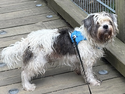
Here is my dog's everyday leash:

Recognize the knot?


If it is OK with you, enki, I'm going to call this a 'Strangle Knot'. One of the more secure knots I know--I use it for so many purposes. I use it so often that sometimes I think I should learn a few new knots!




Hello! It looks like you're interested in this conversation, but you don't have an account yet.
Getting fed up of having to scroll through the same posts each visit? When you register for an account, you'll always come back to exactly where you were before, and choose to be notified of new replies (either via email, or push notification). You'll also be able to save bookmarks and upvote posts to show your appreciation to other community members.
With your input, this post could be even better 💗
Register Login