
Beautiful and Strange Old Cars
-
Renault 4 (in Belgium simply referred to as R 4)
The Renault 4, also known as the 4L (pronounced "Quatrelle"), is a hatchback economy car produced by the French automaker Renault between 1961 and 1992. It was the first front-wheel drive family car produced by Renault.
The car was launched at a time when several decades of economic stagnation were giving way to growing prosperity and surging car ownership in France. The first million cars were produced by 1 February 1966, less than four and a half years after launch. Eventually over eight million were built, making the Renault 4 a commercial success because of the timing of its introduction and the merits of its design. It was exceptionally spacious for its size, and although regarded as a small estate car when launched, it is now seen as the first hatchback family car.
The Renault 4 was Renault's response to the 1948 Citroën 2CV. Renault was able to review the advantages and disadvantages of the 2CV design and come up with a larger, more urban vehicle. In early 1956, Renault Chairman Pierre Dreyfus launched this new project: designing a new model to replace the rear engined 4CV that would become an everyman's car, capable of satisfying the needs of anybody. It would be a family car, a woman's car, a farmer's car, a city car.
The Renault 4 was a basic car with a simple dashboard and sliding windows. Suspension and seats were designed for comfort, and ventilation and the heater were effective.


-
It seems auto makers were creative back then. It seems now auto makers sit on design till the other guy releases a product then they copy it and make "improvements", look at all the CUVs out in the market in the US for example. This segment of the market is very similar with the exception of the badging.
-
This video showcases some of the most intriguing <u>concept cars of the past</u>.
The Buick "Y-job" was the first concept car. It was also the first to be equipped with power windows!
The '51 Buick Lesabre sported a rain sensor that would trigger the convertible top switch when it would get wet.
Notice something familiar about the '55 Lincoln Futura? It was the car that George Barris modelled the original Batmobile after!
- YouTube
Auf YouTube findest du die angesagtesten Videos und Tracks. Außerdem kannst du eigene Inhalte hochladen und mit Freunden oder gleich der ganzen Welt teilen.

(www.youtube.com)
-
-
What happens if people from the aircraft industries start building cars:
1928 Martin Model 100

1948 Martin Martinette

1932 Helicron No. 1

-
@Mike, Lord of the Spammers! said:
Mini Moke anyone? Cool looking in an odd sort of way, and probably the ultimate summer car, from the country that never gets one! :DSent from my Nexus 7 using Tapatalk
to me (after seeing one on Wheeler Dealers) it's like the misfit child of a VW buggy and a Jeep...


=


-
-
Your not wrong Micah :D
Sent from my Nexus 7 using Tapatalk
-
The Atomic Car
During the 1950s, much of the world was quivering with anticipation over the exciting prospects of nuclear power. Atomic energy promised to churn out clean, safe electricity that would be "too cheap to meter." It seemed that there was no energy problem too large or too small for the mighty atom to tackle during the glorious and modern Atomic Age.
It was during this honeymoon with nuclear energy-- in 1957-- that the Ford Motor Company unveiled the most ambitious project in their history: a concept vehicle which had a sleek futuristic look, emitted no harmful vapors, and offered incredible fuel mileage far beyond that of the most efficient cars ever built. This automobile-of-the-future was called the Ford Nucleon, named for its highly unique design feature... a pint-size atomic fission reactor in the trunk.
Ford's nuclear automobile embodied the naive optimism of the era. Most people were ignorant of the dangers of the atomic contraption, as well as the risk that every minor fender-bender had the potential to become a radioactive disaster. In fact, the Nucleon concept was often received with great enthusiasm.
Ford never produced a working prototype, nevertheless the* Nucleon* remains an icon of the Atomic Age.


-
Tatra 603
The Tatra 603 was a large rear-engined luxury car made by the Czechoslovak company Tatra.
The Model T603 was allocated only to senior members of the political and industrial establishments. About a third of T603 production was exported to most of the central and eastern European countries allied to Czechoslovakia at the time, as well as to Cuba and China.
Sales to private individuals were not normally possible, although a few T603s appear to have been privately owned in East Germany. During the car's twenty-year production run, 20,422 cars were built, mostly by hand. To the west of the Iron Curtain the car was unknown, though some were used by Czechoslovak embassies in western capitals.
The first model of 603 was characterized by three headlamps; the central one was linked to the steering, making it possible to turn this lamp with steering (feature already used on T77a in 1934).
The interior featured enough space to seat six occupants. To gain enough space for the middle occupant in the front seats the shift lever was placed under the steering wheel, rather than on the floor. The front seats could be folded down to make a large bed which could be used by up to four people.


-
The Tatra 603 in action.
I just love that car! :D
- YouTube
Auf YouTube findest du die angesagtesten Videos und Tracks. Außerdem kannst du eigene Inhalte hochladen und mit Freunden oder gleich der ganzen Welt teilen.

(www.youtube.com)
-
@Wilfried said:
The Atomic CarDuring the 1950s, much of the world was quivering with anticipation over the exciting prospects of nuclear power. Atomic energy promised to churn out clean, safe electricity that would be "too cheap to meter." It seemed that there was no energy problem too large or too small for the mighty atom to tackle during the glorious and modern Atomic Age.
It was during this honeymoon with nuclear energy-- in 1957-- that the Ford Motor Company unveiled the most ambitious project in their history: a concept vehicle which had a sleek futuristic look, emitted no harmful vapors, and offered incredible fuel mileage far beyond that of the most efficient cars ever built. This automobile-of-the-future was called the Ford Nucleon, named for its highly unique design feature... a pint-size atomic fission reactor in the trunk.
Ford's nuclear automobile embodied the naive optimism of the era. Most people were ignorant of the dangers of the atomic contraption, as well as the risk that every minor fender-bender had the potential to become a radioactive disaster. In fact, the Nucleon concept was often received with great enthusiasm.
Ford never produced a working prototype, nevertheless the* Nucleon* remains an icon of the Atomic Age.
I had this one as a toy car when I was a child :D, never knew it was supposed to be nuclear powered
-
-
-
Horch 853A Spezialcabriolet
According to Richard Owen of supercars.net:
*There's no question that Germany was at the forefront of automotive engineering in the 1930s. Ferdinand Porsche launched the seminal Volkswagen Beetle while Mercedes-Benz and Auto Union were dominating Grand Prix racing. Furthermore, companies like Horch and Mercedes-Benz were producing luxury cars that challenged the rest of the world with their advanced aerodynamic design. Such is the case with our 1938 Horch. It was intricately crafted by Voll & Ruhrbeck of Berlin and can currently be considered their most elegant design.
Germany was the very first country to produce a streamlined coupe. The Mercedes-Benz 500K Autobahnkurier of 1934 caused a sensation at the Berlin Motor Show and motivated Ettore Bugatti to go back to Molshiem and design his Type 57S Aérolithe. Both these cars were influenced by aviation design and the functional beauty of the aerofoil. Not long afterwards Italian, French and American designers caught onto this trend. *


-
1936 Stout Scarab
When the Stout Scarab was introduced, there was nothing on the road quite like it. Its 90 horsepower Ford flathead V8 was mounted in the rear providing lots of room to accommodate passengers inside. Outside, it looked more like it was built by an airplane designer than by an automaker. In-fact, it was. William B. Stout served as chief engineer of Packard's aircraft division during World War I. After the War, he designed a high-winged monoplane without the struts and wires that characterized earlier aircraft. Still later, his design for a three-engine commercial aircraft served as the inspiration for the successful Ford Tri-Motor.
Inspired by aviation techniques, the Scarab - named after the hard-shelled Egyptian beetle - with its metal panels over a framework of tubing, took much of its strength from what was essentially an exoskeleton.
Not only was the exterior and much of its design revolutionary, the interior packaging was most astonishing. Unlike its contemporaries, the fenders were incorporated into the body and the running boards dispensed with - thus reducing wind resistance and interior noise. Flush window glass and hinges were quite novel, too; as was flow-through ventilation with dust filter, thermostatically controlled heat, electric door locks, movable seating (including a table), and indirect interior lighting.


-
Ford Rambler, short life span but super cool car and what a trip around the world as far as assembly.
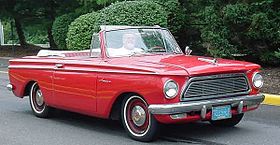


 :D

Hello! It looks like you're interested in this conversation, but you don't have an account yet.
Getting fed up of having to scroll through the same posts each visit? When you register for an account, you'll always come back to exactly where you were before, and choose to be notified of new replies (either via email, or push notification). You'll also be able to save bookmarks and upvote posts to show your appreciation to other community members.
With your input, this post could be even better 💗
Register Login


