
Vintage SAK Owners Club
-
@jnoxyd said:
There are another two knives I've not seen often: 84mm "Hiker" and ""Camper" small, mod. 137kU and 237k. Who of you has such knives?I have both. The small Camper 237k was a regular catalog model and actually a pretty common model pre-1950. It shows up with some frequency until about 1970 and then... nothing. I have several including a 4 pin version from pre-1920 (in rough shape unfortunately).
The Hiker Small is an interesting one. It doesn't ever seem to be a regular catalog model, but I have seen a few that appear to be special runs from the late 1940s (crab claw can opener, etc) through the 1960s. Here's one I found NIB that was clearly a special order from the mid 1960s:

The thing I like about these models is that they are very unusual but you could get them made today if you wanted. None of the parts in these knives are out of production.
-
@jazzbass said:
Very nice find. This is only the third one of these I've ever seen. ColoSwiss had one with MOP scales and I have a red scaled version with bail (that I got from ColoSwiss for a SwissChamp XL). 145ka for yours, 145kaU for mine. All look to be from around the same time period (late 1960s) but with different variants could be three separate production runs. Which would make you think there were more of them out there, but no... they're one of the rarest post WWII 84mm knives.Here`s another one with original sheet, produced for General Motors, end of the 50-ies.

-
@wengercollector said:
Here`s another one with original sheet, produced for General Motors, end of the 50-ies.It's a beautiful SAK. Thanks for posting this image. I don't have this model, unfortunately, but here is a first generation Hiker small of the kind mentioned above by JAZZBASS.

-
I just posted links to several Victorinox catalog compilations in the catalogs thread. I find it intriguing how some of the recent discussion here seems to be reflected in differences that can be observed between the "Gesamt-Katalog bis 1970" and the "Gesamt-Katalog bis 1980." The attached image shows, side by side, the catalog page with the list of Victoria officer's knife models from the "Gesamt-Katalog bis 1970" (I'm guessing that the actual page is from the early 1960's) and the corresponding page from the "Gesamt-Katalog bis 1980" (I'm guessing that the actual page is from the early 1970's).
Most of the changes involve models getting manually deleted in the newer catalog. I believe that this reflects the withdrawal of these models in the early 1970's or slightly before then. One can see, in particular, the withdrawal of most 84mm models with more than two layers (with the notable exception of the three layer models with scissors), as discussed above by JAZZBASS. There are also some other subtle differences, such as the fact that model 136mU in the older catalog is replaced by model 136maU in the newer one (something that was also discussed above).

-
@MiniChamp said:
I just posted links to several Victorinox catalog compilations in the catalogs thread. I find it intriguing how some of the recent discussion here seems to be reflected in differences that can be observed between the "Gesamt-Katalog bis 1970" and the "Gesamt-Katalog bis 1980." The attached image shows, side by side, the catalog page with the list of Victoria officer's knife models from the "Gesamt-Katalog bis 1970" (I'm guessing that the actual page is from the early 1960's) and the corresponding page from the "Gesamt-Katalog bis 1980" (I'm guessing that the actual page is from the early 1970's).Most of the changes involve models getting manually deleted in the newer catalog. I believe that this reflects the withdrawal of these models in the early 1970's or slightly before then. One can see, in particular, the withdrawal of most 84mm models with more than two layers (with the notable exception of the three layer models with scissors), as discussed above by JAZZBASS. There are also some other subtle differences, such as the fact that model 136mU in the older catalog is replaced by model 136maU in the newer one (something that was also discussed above).
Excellent! Am I being thick, or might the documents be Jan '69 and comparing Jan '69 to July '71?

-
@wengercollector said:
Here`s another one with original sheet, produced for General Motors, end of the 50-ies.Very, very nice example!
 Could I ask for pictures of the top and ends?
-
@kamakiri said:
might the documents be Jan '69 and comparing Jan '69 to July '71?Probably not. While I don't know what the numbers are, I don't think that they designate dates (also XII isn't 7 and the right page doesn't seem to be doing by itself any kind of comparison). Moreover, the theory about 136mU being replaced by 136maU around 1966 suggests that the left page is from before 1966.
@kamakiri said:
On the first/left doc, it would be nice to have the pics that correlate to: "the 12 illustrated models" and "the other 24 master-selling models"??? A picture of "the 12 illustrated models" is precisely the content of the preceding page in each of the actual PDF Gesamt-Katalog documents. I'm not familiar with any picture of "the other 24 best-selling models."
-
@MiniChamp said:
Probably not. While I don't know what the numbers are, I don't think that they designate dates (also XII isn't 7 and the right page doesn't seem to be doing by itself any kind of comparison). Moreover, the theory about 136mU being replaced by 136maU around 1966 suggests that the left page is from before 1966. Typing before thinking again! Even if I said 'December'...still doesn't really fit with the 136x example as discussed.
@MiniChamp said:
??? A picture of "the 12 illustrated models" is precisely the content of the preceding page in each of the actual PDF Gesamt-Katalog documents. I'm not familiar with any picture of "the other 24 best-selling models."Oops, again. Counted 13 on the page and figured it was the wrong picture. And now see that the 24 aren't pictured.
-
Nice set, jnoxyd!
I'd say the first one is late '50s/early '60s. Just because it could be '60/'61 too.
I think the middle one is mid-60's at the earliest. Pretty sure after say '63-'64. Scissor spring isn't silver, saw isn't polished, and the tweezer doesn't look nickel silver in the pic. Good chance after '66 since it's a Hoffritz.
The third one could be into the early '70s. Like '70 or '71 construction. And again, possibly later because Hoffritz.I have one almost exactly like that, but with the file on the phillips.
The one I have that is c. '76 is H/VSSR and the newer 'smooth'/square phillips. In 91mm, those tang stamps are used in the '73 to early '76 range.
.......
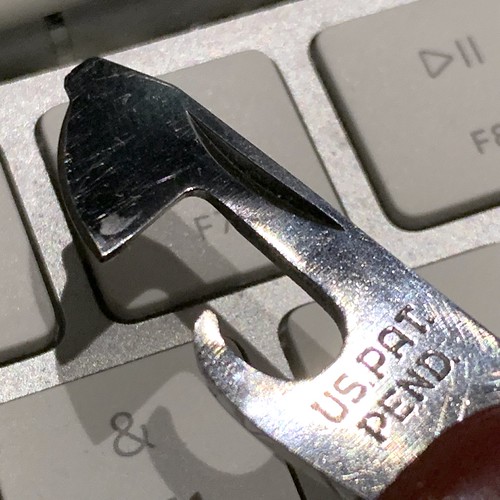
Craftsman pre-'51 and c. '51 US. PAT. PEND.



-
@wengercollector said:
Here`s another one with original sheet, produced for General Motors, end of the 50-ies.That knife is fantastic! Is this in your collection? I have some questions if so.
-
@jnoxyd said:
Returning to 84mm Master Craftsman:
Three wood saw types:

Great picture. From this era you're only missing one variation - the very hard to find 25T asymmetric polished. I have that in a Camper Small, Artisan and Huntsman Small from the early 60s (small awl). It's weird because it's almost like they went 35TAP > 25TAP > 35TAM > 25TSM*.
(T = tooth, A = asymmetric, S = symmetric, P = polished, M = machined)
-
@kamakiri said:
And I should have asked what 'bird head' spacer is on the middle one. I suspect nickel silver and not aluminum. I'd expect aluminum on early '60s with hidden awls.I've seen you asking about the pen blade spacer - what exactly would you like to know about these?
BTW - have you posted pics of your 136kmaU from 1976? Love to see those - that's the latest one of these I know of.
-
@jazzbass said:
I've seen you asking about the pen blade spacer - what exactly would you like to know about these?I'm trying to use it as a tool to date knives in the mid-'60s. Use of aluminum seems pretty consistent for indicating early 60's and nickel silver used exclusively after some date. It seems to differ enough from other mid-'60s features like saw teeth and polishing and the earlier tweezer head material change over.
@jazzbass said:
BTW - have you posted pics of your 136kmaU from 1976? Love to see those - that's the latest one of these I know of.This is what I could find quickly. I might have more in the Hoffritz threads.

Back is VSSR stamped

Top knife here, obviously:

-
@kamakiri said:
I'm trying to use it as a tool to date knives in the mid-'60s. Use of aluminum seems pretty consistent for indicating early 60's and nickel silver used exclusively after some date. It seems to differ enough from other mid-'60s features like saw teeth and polishing and the earlier tweezer head material change over.In the taxonomy I developed for my collection, I call the time period from 62-69 the "late vintage" or LVNT period. In the LVNT period there is a change from thin 1.0mm aluminum pen blade spacer to nickel silver. In general this coincided with the change from polished to machined saws and silver > black scissor springs.
Thin aluminum spacers come into being in the last part of the "mid vintage" (57-62) period. Prior to that they used a thicker 1.5mm spacer that was either aluminum or nickel silver in no way that seems to indicate preference. The thicker spacer goes away when the main/pen blade backspring is redesigned c 1960 to go from a design that was thicker at the pen blade side to one that was of uniform thickness (roughly 2.75mm).
-
@MiniChamp said:
??? I'm a little confused by this statement. Are you proposing that they actually did something else? If so, what?Is it my odd naming that is confusing? Or the chronology? AFAIK, the chronology of the 84mm wood saw goes like this:
c. 1955: 35TAP
c. 1963: 25TAP (this is the rare one)
c. 1963: 35TAM
c. 1966: 25TSMI find it interesting that they tried the 25TAP saw very briefly after about a year into the LVNT period, but then got rid of it almost immediately in favor of the older 35T saw (this time machined and not polished). I'd love to know why they didn't like the 25TAP version.


Hello! It looks like you're interested in this conversation, but you don't have an account yet.
Getting fed up of having to scroll through the same posts each visit? When you register for an account, you'll always come back to exactly where you were before, and choose to be notified of new replies (either via email, or push notification). You'll also be able to save bookmarks and upvote posts to show your appreciation to other community members.
With your input, this post could be even better 💗
Register Login


